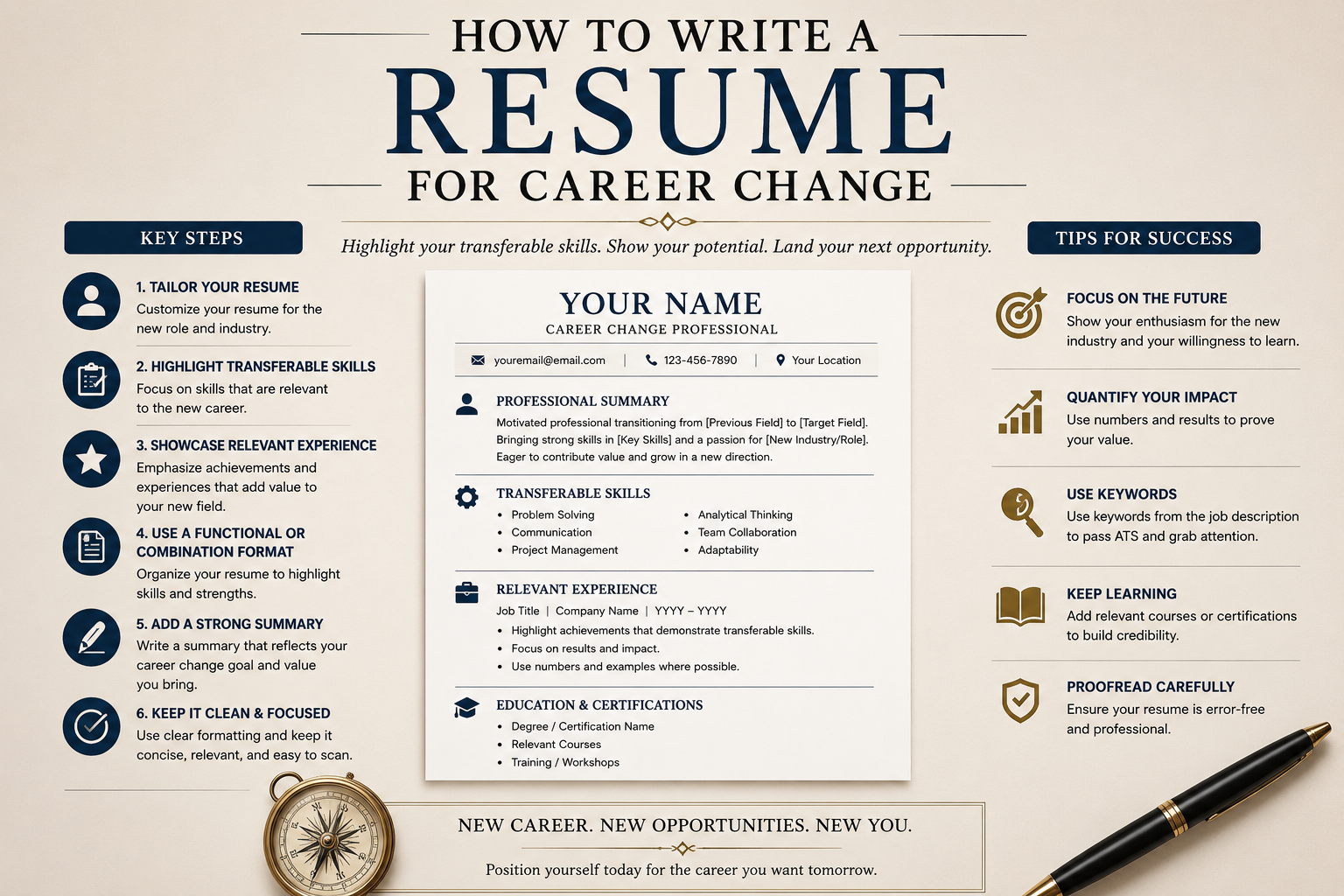
How to Write a Resume for a Career Change – The 2026 Guide
Introduction: Your Career Change Starts Here
You've spent years building expertise in one field. Maybe you're a teacher who wants to move into corporate training. Or a software developer dreaming of a project management role. Perhaps you're a marketing professional eyeing a switch to UX design.
Whatever your situation, here's the truth that might surprise you: changing careers isn't about starting over—it's about repackaging what you already know. The average American has a dozen jobs over their lifetime, and today's professionals are more likely than ever to make non-linear moves. You're not alone, and more importantly, you're not starting from zero.
This guide will walk you through exactly how to write a resume that bridges the gap between where you are and where you want to go. No fluff. Just practical, step-by-step strategies that actually work.
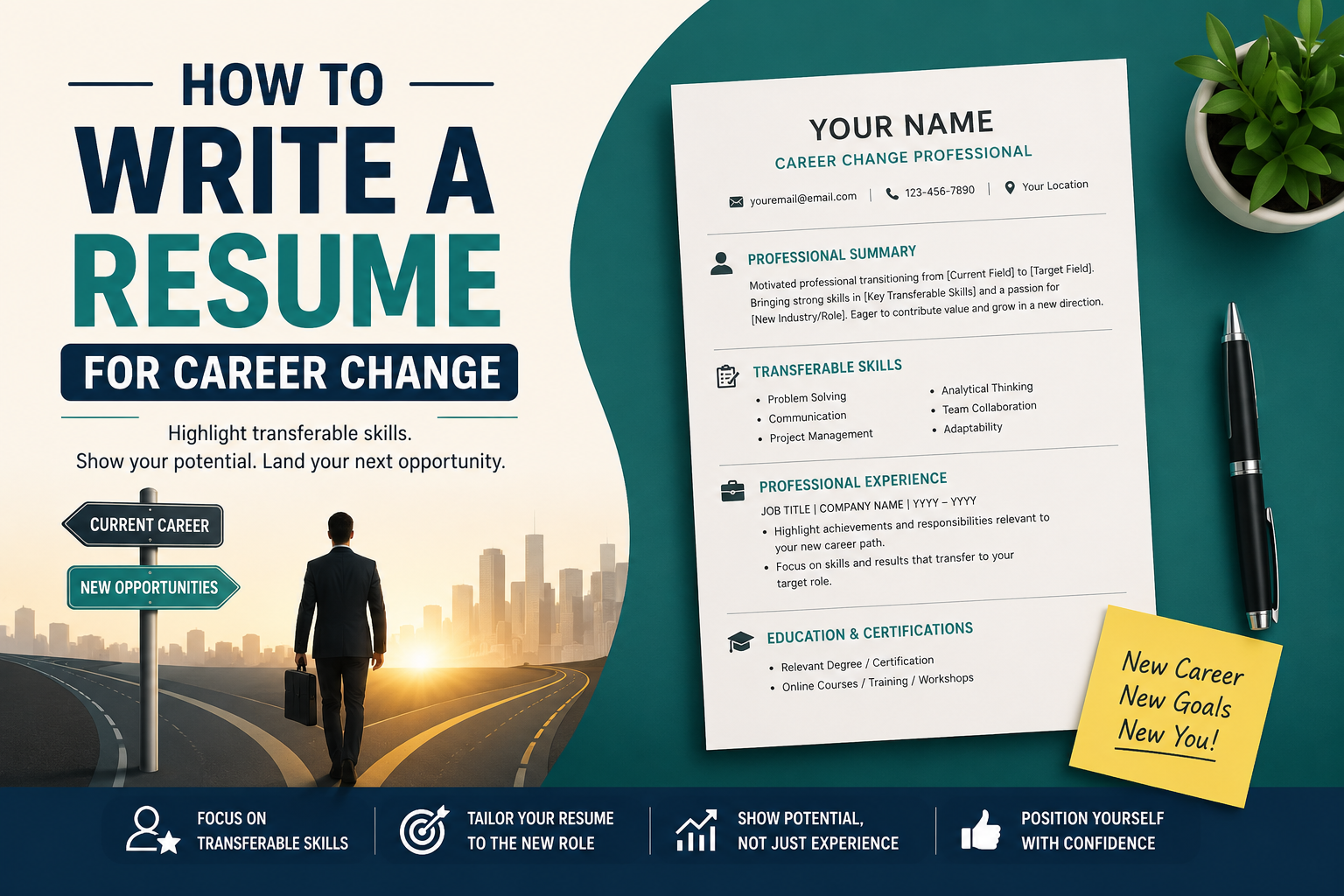
Chapter 1: Before You Write a Single Word – Do Your Homework
Understand Your New Industry: Before you open that resume template, you need to understand what employers in your target field are actually looking for. This is the foundation for everything else.
Action steps:
- Analyze job descriptions: Review 5-10 job postings for your target role and note repeated skills, tools, certifications, and responsibilities
- Conduct informational interviews: Connect with professionals in your desired field and ask what skills and experience matter most
- Review industry content: Read articles, blogs, and publications to understand trends and terminology
- Research company culture: Look at mission statements, values, and employee LinkedIn profiles to understand what employers value
Identify Your Transferable Skills: This is your secret weapon. Transferable skills are abilities you've developed in one context that apply to completely different roles.
Common transferable skills that employers value:
- Project management: Organizing budgets, schedules, and teams
- Communication: Writing reports, public speaking, facilitating meetings
- Leadership: Managing teams, mentoring, training new hires
- Problem-solving: Analyzing data, troubleshooting issues, improving workflows
- Time management: Prioritizing tasks, meeting deadlines
Create a Master Copy of Your Resume: Think of this as your foundation—a resume you can quickly tailor to different job postings without starting from scratch each time. This saves time and ensures consistent formatting across all versions.
Chapter 2: Choose the Right Format
The format you choose makes a huge difference for career changers. Here's what works best:
The Three Resume Formats:
Lists work history in reverse order
Best for: Staying in the same field
Pros: Familiar to recruiters
Cons: Emphasizes past job titles over transferable skills
Focuses on skills instead of work history
Best for: Limited direct experience
Pros: Highlights your abilities
Cons: Some employers are unfamiliar with it; can be harder for ATS
Blends skills section with chronological work history
Best for: Career changers
Pros: Shows skills first while still providing work history
Cons: Requires more effort to write
Why the Combination Format Works Best: The combination (or hybrid) format is widely recommended for career changers because it:
- Leads with your strengths by putting skills and achievements first
- Still provides context through a clear employment timeline
- Works well with ATS systems (unlike purely functional formats)
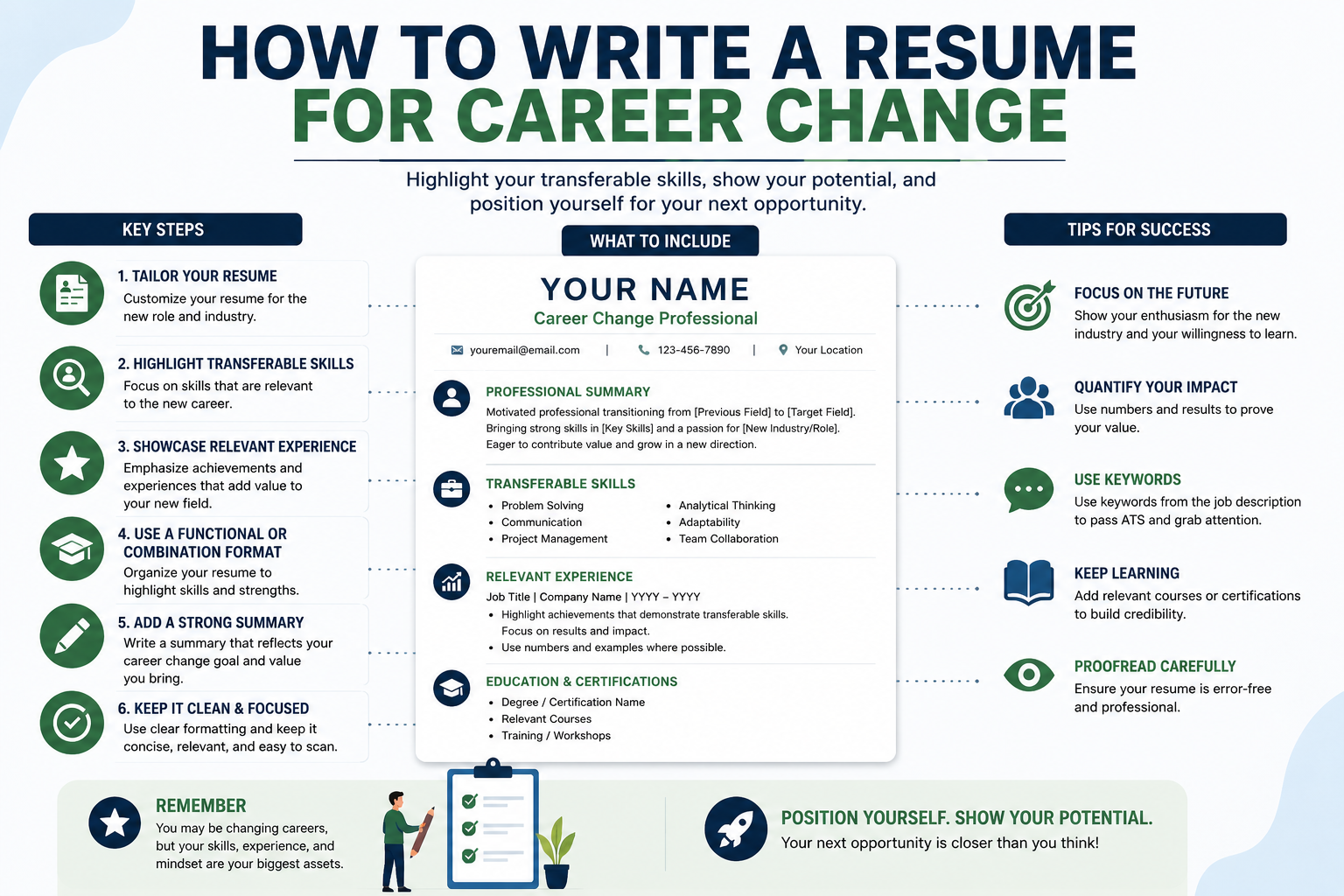
How to structure it: Contact Information → Professional Summary → Skills Summary / Core Competencies → Certifications & Training (if relevant) → Work Experience (reverse chronological) → Education
Chapter 3: Your Professional Summary – The Elevator Pitch
This is the first thing recruiters read. Make it count.
Your professional summary (or objective) should:
- Clearly state your career transition – be transparent about the change
- Highlight transferable skills – show how your background adds value
- Express enthusiasm for your new field
- Mention relevant training or certifications you've earned
"Detail-oriented operations leader with 6+ years of retail management experience overseeing teams, scheduling, and daily operations. Known for improving workflows and delivering strong customer experiences. Bringing established administrative, communication, and coordination skills to an office administration role."
"Marketing coordinator transitioning into data analytics after completing recent coursework in Excel, SQL, and data visualization. Seeking an entry-level data analyst role where strong analytical thinking and newly developed technical skills can support data-driven decision-making."
Chapter 4: Your Skills Section – Show, Don't Just Tell
This is where you prove your value. Focus on transferable skills first, then add relevant hard and soft skills.
Transferable Skills to Highlight: These are the competencies that carry across industries:
- Communication and presentation
- Project coordination and organization
- Leadership and team support
- Problem-solving and decision-making
- Time management and prioritization
How to List Skills Strategically: Instead of a simple list, organize your skills into categories relevant to your target role.
Before & After: Translating Experience
Classroom management
Lesson planning
Resolving customer issues
Managing budgets
Group facilitation and training delivery
Curriculum development
Employee relations and support
Financial planning and reporting
Chapter 5: Your Work Experience – Reframe, Don't Rewrite
You don't need to hide your past experience. You need to show how it connects to your future goals.
Strategies for Reframing Experience:
1. Focus on accomplishments, not duties: Instead of listing what you were responsible for, highlight what you achieved. Use numbers wherever possible.
- Weak: "Managed social media accounts"
- Strong: "Developed social media strategy that grew followers by 25% in 3 months and increased engagement by 40%"
2. Use transferable language: Mirror the vocabulary from job descriptions in your target field.
3. Highlight relevant achievements: If you led a team, managed a budget, or solved a complex problem, feature those accomplishments prominently.
Below is how someone moving from software sales to software development might frame their experience:
Technical Projects and Freelance Development
Self-Employed | 2024–Present
• Built responsive web applications and automation tools to strengthen programming skills
• Developed scripts to automate data reporting, improving efficiency
• Maintained GitHub portfolio showcasing coding projects
Senior Software Sales Representative
Cloud Systems LLC | 2020–2024
• Led product demos explaining software functionality, integrations, and system architecture
• Partnered with product and engineering teams to communicate customer feedback
• Built CRM dashboards to analyze pipeline performance and customer trends
Chapter 6: Certifications, Training & Education
If you've invested in learning for your new career, show it off. This demonstrates commitment and bridges the experience gap.
What to Include:
- Completed certifications
- Online courses (Coursera, Udemy, LinkedIn Learning, etc.)
- Workshops and industry training
- Relevant coursework from your degree
- In-progress training (shows momentum)
Certifications & Professional Development
• Google Data Analytics Certificate, Coursera (Completed 2025)
• SQL Fundamentals for Data Reporting, Udemy (Completed 2025)
• Data Visualization With Tableau, Coursera (Completed 2024)
Education Section: If your degree isn't directly related to your target field, include relevant coursework or projects that show your alignment.
Education
B.A. in Communications, State University | 2020
Relevant Coursework: Project Management, Digital Marketing, Data Analysis
Senior Project: Developed a full marketing campaign for a local business, increasing their engagement by 30%
Chapter 7: Keywords Are Critical
Most companies—including 99% of Fortune 500 organizations—use Applicant Tracking Systems (ATS) to screen resumes. These systems look for specific keywords from the job description.
How to Find the Right Keywords:
- Read the job description carefully – note repeated skills and qualifications
- Mirror the language exactly – if they say "project management," don't say "task coordination"
- Include a mix of hard skills, soft skills, tools, and certifications
- Use keywords in your skills section, summary, and experience bullets
Industry-Specific Keyword Examples:
Python, Java, AWS, SQL, Agile, DevOps
PMP, Scrum, Waterfall, Stakeholder Management
SEO, Google Analytics, Content Strategy, CRM
Patient Care, HIPAA, EMR, Clinical Trials
Chapter 8: Addressing the "Why" – Cover Letter Tips
Your cover letter is your chance to explain the story behind your career change. Use it to connect the dots for the employer.
What to Include in Your Cover Letter:
- Personalize it – address the hiring manager by name if possible
- Explain your transition briefly – show passion for the new field
- Highlight transferable skills – use specific examples
- Show enthusiasm – express genuine interest in the company
- End with a call to action – request an interview
"As a financial advisor, I developed expertise in relationship management, strategic planning, and client communication. These skills align perfectly with the customer success role at [Company Name], where I can leverage my ability to build trust and provide data-driven solutions."
Chapter 9: Common Mistakes to Avoid
| Mistake | Why It Hurts | What to Do Instead |
|---|---|---|
| Using a generic resume | Shows lack of effort; ATS rejects it | Tailor every application |
| Listing job duties, not achievements | Doesn't show your impact | Use numbers and results |
| Hiding your career change | Creates confusion | Be transparent about your transition |
| Skipping keywords | ATS won't find your resume | Mirror job description language |
| Including outdated experience | Clutters your resume | Only include what's relevant |
| Typos and formatting errors | Signals carelessness | Proofread carefully |
Chapter 10: Quick Reference Table
| Resume Section | What to Include | Tips for Career Changers |
|---|---|---|
| Professional Summary | Career transition, top transferable skills, enthusiasm | State your change clearly |
| Skills Summary | Transferable skills, hard skills, soft skills | Lead with what's relevant |
| Certifications/Training | Completed and in-progress credentials | Show commitment to new field |
| Work Experience | 3-4 bullets per role, focused on achievements | Reframe duties to show relevance |
| Education | Degrees, relevant coursework | Include recent training |
| Projects/Portfolio | Personal or professional projects | Demonstrate hands-on skills |
FAQ – Your Burning Questions Answered
Conclusion: Your New Career Awaits
Changing careers is a big step, but it's not an impossible one. Your past experience isn't a limitation—it's a foundation. With the right strategy, you can show employers exactly why you're the right fit.
Remember these key takeaways:
- Do your homework – understand what employers want in your target field
- Choose the combination format – it highlights your skills first
- Identify transferable skills – these are your secret weapon
- Tailor every application – use keywords from the job description
- Show your commitment – include certifications, training, and projects
- Tell your story – use your cover letter to connect the dots
- Stay positive – rejections are part of the journey
As a career-change resume writer from ACM notes: "Research the new market and rewrite your resume to match those words. But don't lie. Always tell the truth, and don't stretch the truth."
Your skills are valuable. Your story is unique. And your next career is waiting. Now go build that resume and take the first step. 🚀