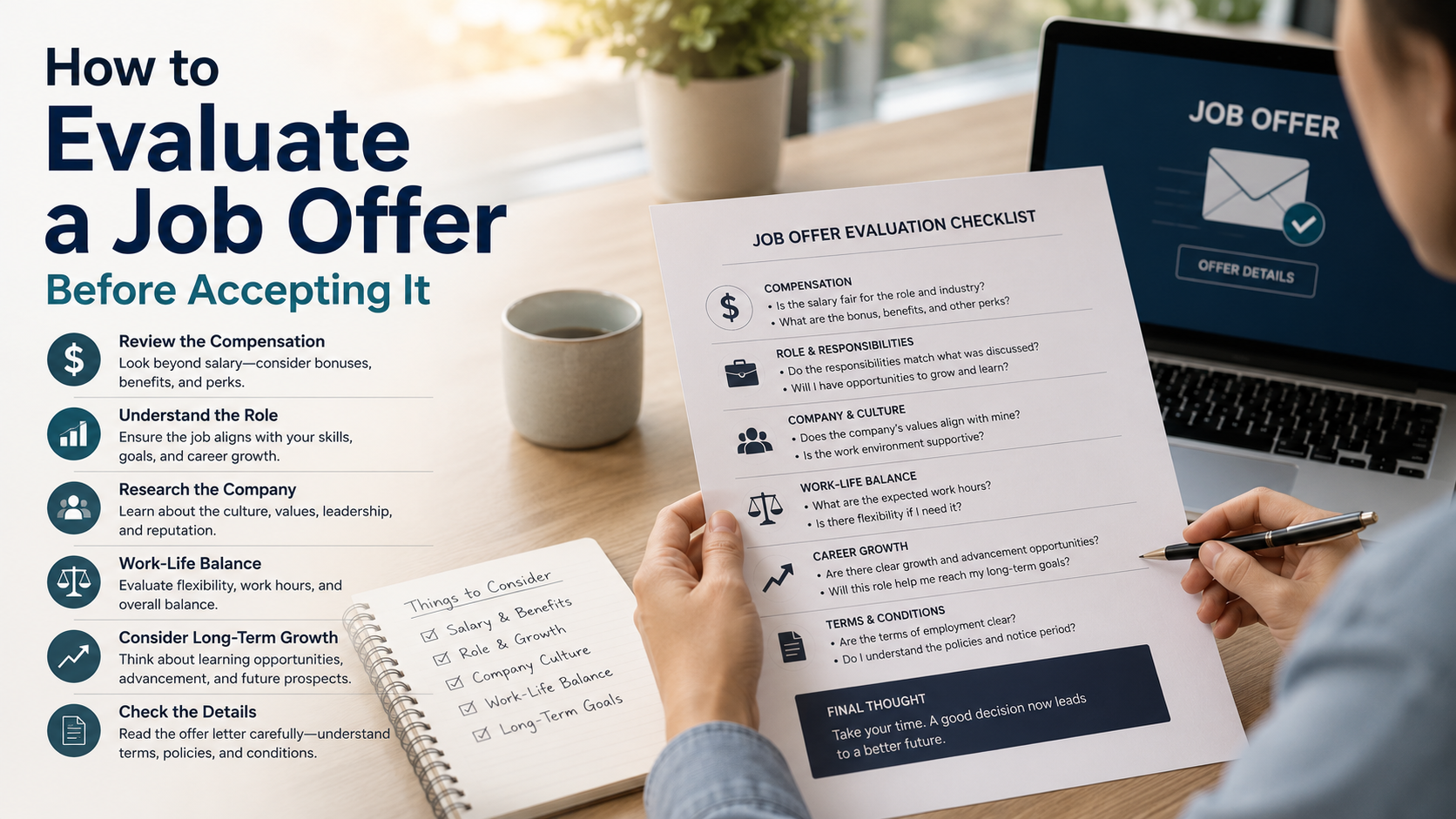
How to Evaluate a Job Offer Before Accepting It – Your 2026 Guide
"Congratulations! We'd like to offer you the position."
After weeks or months of applications, interviews, and waiting, those words feel amazing. Your first instinct might be to say "yes" immediately. Resist it.
A job offer isn't just an invitation—it's a major life decision that will affect your finances, well-being, and career trajectory for years to come. It's completely reasonable, even expected, to take time and think it through.
This guide breaks down everything you need to consider before signing that offer letter, from the obvious (salary) to the easily overlooked (your boss's management style). Let's make sure you say "yes" for the right reasons.
Chapter 1: The First Step – Pause and Breathe
When you receive an offer, the excitement (or relief) can be overwhelming. It's in your best interest to slow down and fully consider your next steps.
What to Do Immediately:
- Listen carefully and take notes – If the offer comes over the phone, write down key details
- Request written details – Ask for the offer in writing so you can review everything properly
- Express gratitude – Always thank the employer for the opportunity
- Ask about the deadline – Clarify when they need a response
- Don't commit on the spot – Avoid accepting, declining, or negotiating immediately
Chapter 2: The Big Picture – What to Evaluate
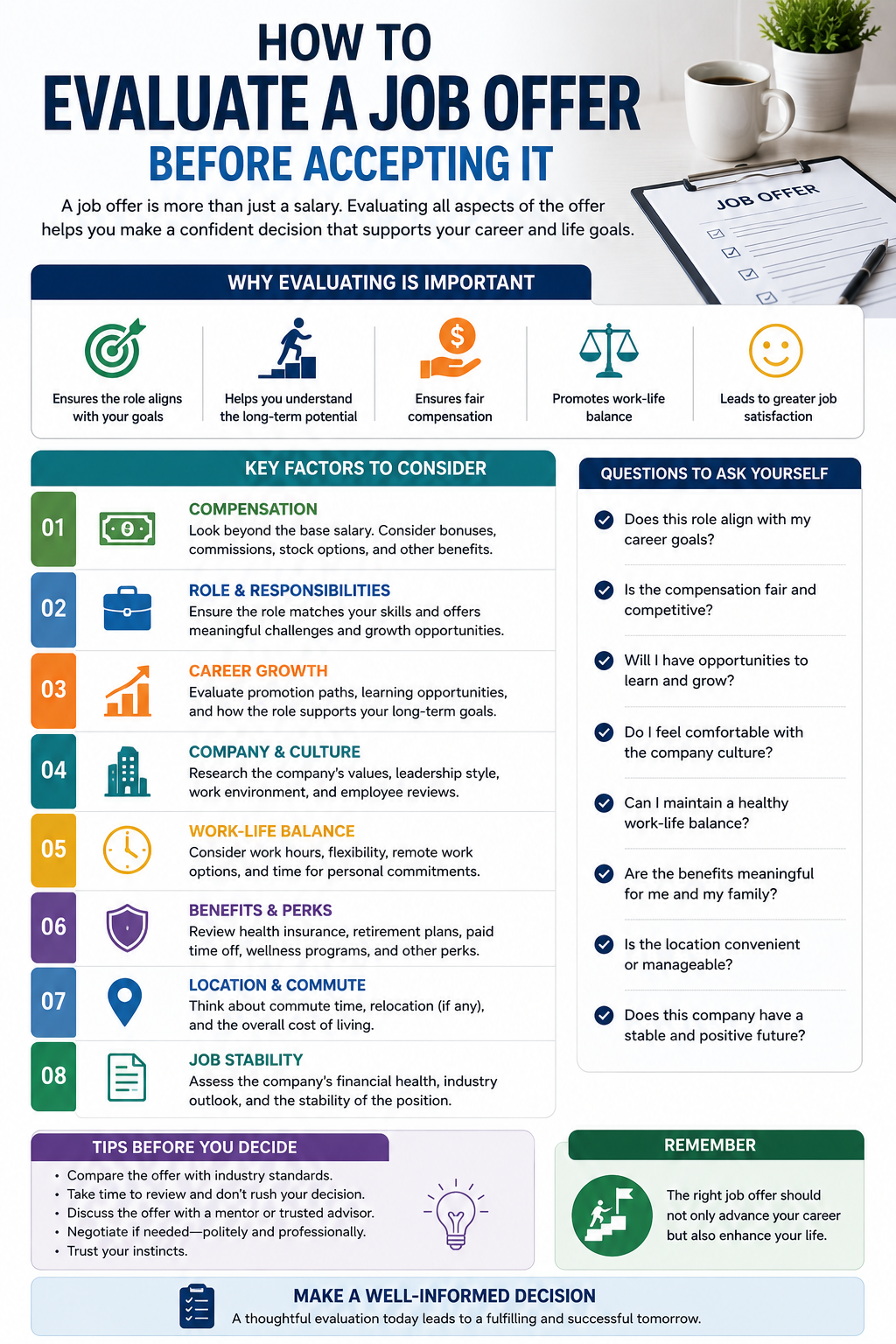
A job offer is more than just a salary. It's a package that includes compensation, benefits, work environment, and growth potential. Here are the key areas to assess.
• Are the day-to-day tasks stimulating and satisfying?
• Do they use your skills and help you develop new ones?
• Where will this position lead you?
• If anything feels unclear, reach out for clarification
• Did you feel comfortable with their management style?
• Will they be a good mentor?
• Are they respectful, clear, and communicative?
• Do they show signs of emotional intelligence?
• How was your connection with interviewers?
• Does the team work collaboratively or independently?
• If you notice a pattern of people leaving quickly, that's a red flag
• Is the base salary competitive? (Use Glassdoor, Salary.com)
• Consider bonuses, commissions, stock options
• Evaluate health insurance, retirement plans, paid time off
• Use a cost of living calculator for location
• What's the customary number of hours required each week?
• Does the role offer flexible hours or remote options?
• How long is the commute? Is it practical and affordable?
• How much travel is required?
• Is the organization rigid or flexible? Casual or formal?
• Do the mission and values resonate with your own?
• Lean into your gut feeling – did you feel excited or anxious?
• Does the job offer clear paths for promotion?
• What new skills and experiences will you gain?
• Will you have access to mentorship and training?
• Is the company growing and financially stable?
Chapter 3: The Decision Matrix – Comparing Multiple Offers
If you're fortunate enough to have multiple offers, the decision can be even harder. A simple pros-and-cons list often isn't enough because it treats all factors equally. A "decision matrix" helps you compare offers objectively by assigning weights to what matters most to you.
How to Build Your Matrix:
- List Your Criteria: These are the factors that matter most to you. For example, "Job Security," "Salary," "Work-Life Balance," "Growth Opportunity," "Company Culture"
- Assign Weights: Not all criteria are equal. Give each a "weight" (e.g., x3 for "Critical," x2 for "High Importance," x1 for "Nice to Have") based on its importance to you
- Score Each Offer: For each offer, give every criterion a raw score from 1 to 5 (5 being excellent)
- Calculate Totals: Multiply each raw score by its weight, then add up the totals for each offer. The highest score is the objective winner
Chapter 4: If You Need More Time or Want to Negotiate
Asking for More Time: It's professional to ask for more time to consider an offer, especially if you have other applications in progress.
If you're waiting on another employer: Reach out to them immediately to let them know you have an offer and ask about your status.
Preparing to Negotiate: Many offers are not final. Negotiation is often expected, particularly in business, tech, and non-profit sectors. It's about advocating for your value with professionalism, not making demands.
- Do Your Research: Know the market rate for your position based on data from Glassdoor, Salary.com, and cost-of-living calculators
- Know Your Value: Articulate how your skills and experience exceed the job requirements
- Think Beyond Salary: If the base salary is fixed, consider negotiating for other items like a signing bonus, more paid time off, or flexible work arrangements
- Know Your Walk-Away Point: Decide your minimum acceptable offer before you start the conversation
Chapter 5: When It's Time to Say No
After careful evaluation, you might decide the offer isn't right for you. If that's the case, decline gracefully and professionally to avoid burning bridges.
- Lead with gratitude: Thank the employer for their time and the opportunity
- Be polite and direct: Let them know you have decided to decline. You may choose to provide a reason, but be tactful
- End with optimism: "I sincerely appreciate the time you took to share more about your organization. I'm not able to accept this offer, but I hope our paths will cross in the future"
FAQ – Your Burning Questions Answered
Conclusion: Make a Decision You Won't Regret
A job offer is the beginning of a new chapter, not the end of the story. Taking the time to evaluate it carefully ensures you're making a decision that aligns with your goals, values, and lifestyle.
Remember these key takeaways:
- Pause and breathe – don't commit on the spot
- Evaluate the full package – salary, benefits, culture, growth, work-life balance
- Research your potential manager and team
- Use a decision matrix for multiple offers
- Know your worth and negotiate professionally
- Decline gracefully if it's not the right fit
Your career is a marathon, not a sprint. The right offer will set you up for long-term success. Now go make a decision you'll be proud of. 🚀