How to Explain Employment Gaps During an Interview – The 2026 Guide
Introduction: The Truth About Career Breaks
Let's get one thing straight right from the start – having an employment gap does NOT make you a bad candidate.
Life happens. People take time off for all sorts of reasons. Maybe you had to care for a family member. Maybe you were affected by company-wide layoffs. Maybe you took time to travel, study, or simply reassess your career direction. These are all valid reasons, and employers know it.
According to a recent report, 47% of American workers have experienced a career gap at some point. Nearly 70% of professionals experience some form of employment gap during their careers. So if you have one, you're in good company.
The real challenge isn't having a gap – it's how you explain it. In this guide, we'll walk through exactly how to address employment gaps with confidence, honesty, and professionalism.
Chapter 1: Why Employers Ask About Employment Gaps
Before we dive into strategies, let's understand why interviewers ask about gaps in the first place.
What employers are actually trying to figure out:
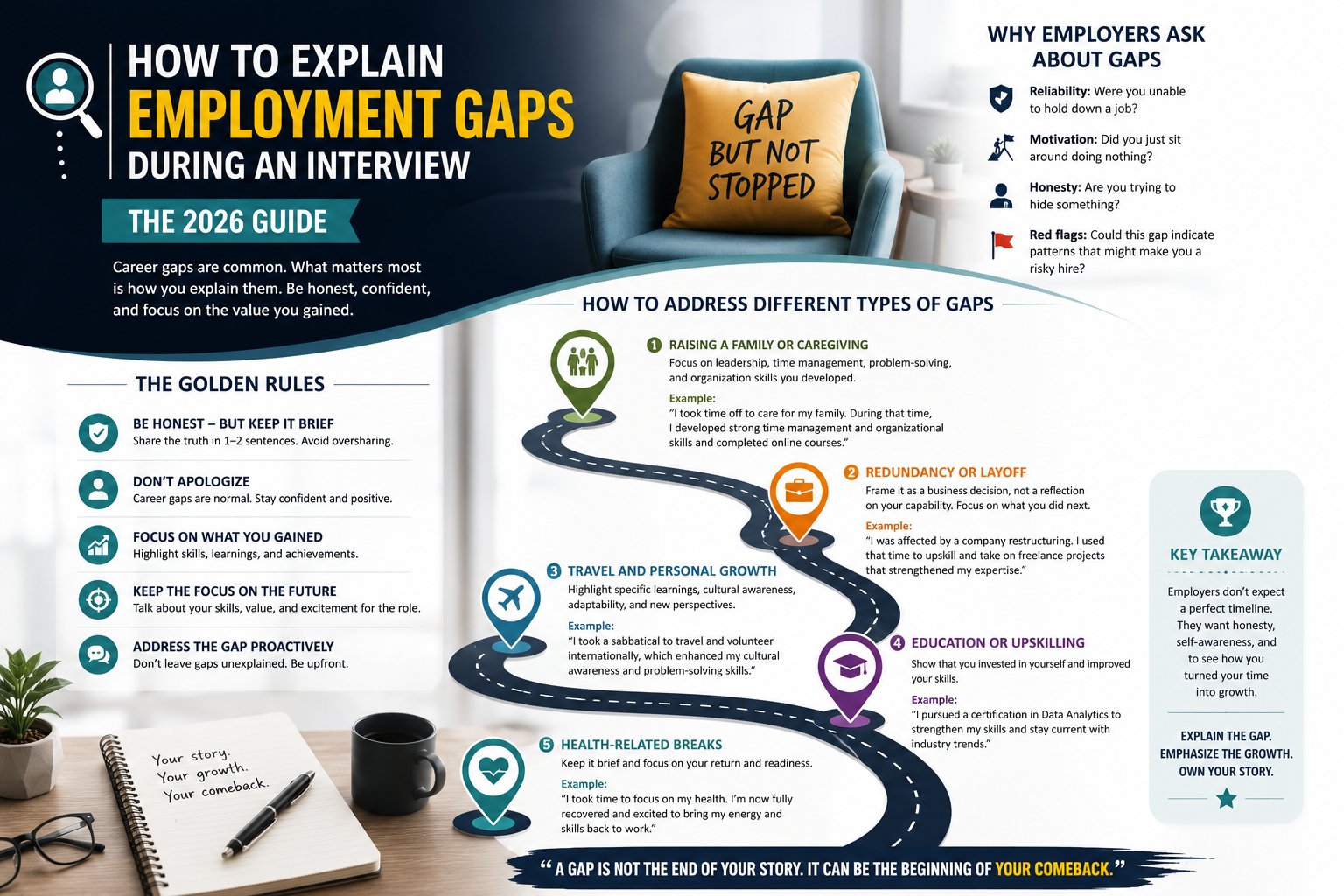
- Reliability: Were you unable to hold down a job?
- Motivation: Did you just sit around doing nothing?
- Honesty: Are you trying to hide something?
- Red flags: Could this gap indicate behavioral patterns that might make you a risky hire?
Here's the thing: Most employers understand that common reasons for gaps include continuing education, gaining new skills, taking care of children or family members, or dealing with health issues. They're not out to get you. They just want to understand your story.
The National Careers Service emphasizes: "Having a gap in your CV is not a problem, but you might be asked about it. The important thing is to be open and honest, and that you're ready to explain what you were doing during any gaps."
Chapter 2: The Golden Rules of Explaining Employment Gaps
Before we get into specific scenarios, here are the golden rules that apply to every employment gap explanation:
- Rule 1: Be Honest – But Keep It Brief. Honesty is non-negotiable. Lying on your resume or during an interview is never a good idea. Hiring managers are skilled at spotting inconsistencies, and most verify work history. But being honest doesn't mean oversharing. A clear, honest explanation in one or two sentences is usually enough.
- Rule 2: Don't Apologize. You haven't done anything wrong. Career gaps are normal. Don't sound defensive or apologetic about your choices. Confidence and self-awareness will always go further than a perfect timeline.
- Rule 3: Focus on What You Gained. Even if you weren't in a formal role, you likely gained valuable life or transferable skills. Volunteering, freelance work, courses, certifications, or even managing family responsibilities all demonstrate continued engagement and skill development.
- Rule 4: Keep the Focus on the Present and Future. Employers are most interested in what you can bring to their organization today. Direct their attention to your recent accomplishments, relevant skills, and enthusiasm for the role.
- Rule 5: Address the Gap Proactively. Don't leave gaps unexplained – that only invites assumptions. Address them directly in your resume, cover letter, or interview.
Chapter 3: How to Address Different Types of Employment Gaps
Different types of gaps require different framing strategies. Let's look at the most common scenarios.
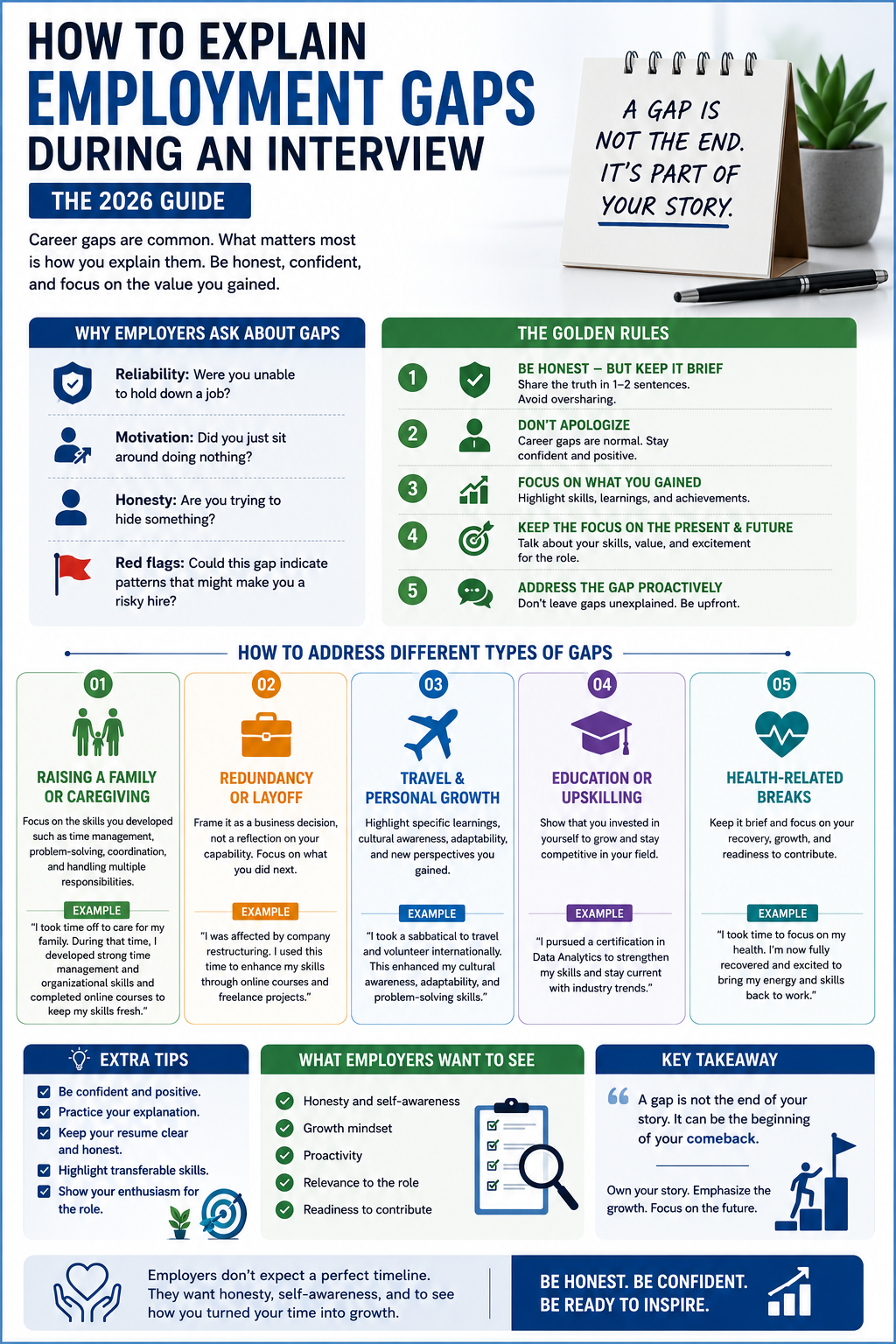
👨👩👦 A. Raising a Family or Caregiving
This is one of the most common reasons for career breaks. Nearly every employer understands this.
How to frame it: Focus on the skills you developed – time management, problem-solving, coordination, managing multiple stakeholders under pressure. These are legitimate leadership experiences.
Sample interview response: "I took time off to raise my children. During those years, I developed strong time management and organizational skills that I believe will make me a more effective employee today. I'm now fully ready and excited to return to work."
📉 B. Redundancy or Layoff
Redundancy is an external event, not a reflection on your capability. What matters is how you responded.
How to frame it: Outline the business decision that led to the redundancy, rather than making it personal. Then focus on what you did next.
Sample interview response: "I was affected by company-wide restructuring at my previous role. I used this transition period to enhance my skills through online courses and freelance projects, which actually strengthened my expertise in areas directly relevant to this position."
✈️ C. Travel and Personal Growth
Travel can be a powerful experience that builds cross-cultural awareness, adaptability, and communication skills.
How to frame it: Avoid generic descriptions about "broadening your horizons." Instead, focus on specific learnings – a language, an industry you observed, a community you engaged with.
Sample interview response: "I took a planned sabbatical to travel and volunteer internationally. This experience enhanced my cultural awareness, adaptability, and communication skills – qualities I know are valuable in today's global workplace."
🩺 D. Health Issues
Health breaks are common and completely valid. You do not need to disclose medical details.
How to frame it: Focus on recovery, reflection, and readiness. Show that you used the time productively and are now fully prepared to return.
Sample interview response: "A health issue required me to step away from work for several months. During recovery, I completed online courses and developed a clearer sense of what I want from my career. I'm fully healthy and prepared for the demands of this role."
📚 E. Returning to Study or Upskilling
This is one of the easiest gaps to explain – it shows initiative and commitment to growth.
How to frame it: Be specific about what you studied, why it was relevant, and how it prepares you for the role.
Sample interview response: "I took time off to complete additional training in full-stack development, which has equipped me with the skills to contribute immediately in this role."
🔄 F. Career Change
A deliberate career break to switch fields shows thoughtfulness and commitment.
How to frame it: Explain how the gap allowed you to make a thoughtful transition. Show that you're entering this field with both passion and relevant skills.
Sample interview response: "I deliberately took time to reassess my career direction and pursue additional training in UX design. This gap allowed me to make a thoughtful transition and enter this field with both passion and relevant skills."
Chapter 4: Addressing Gaps in Your Resume
Your resume sets the tone for how potential employers perceive your career journey. Here are specific strategies:
- Use Year-Based Dates: Consider using years instead of months when listing employment dates. This approach works particularly well for gaps shorter than six months.
- Create a Brief Gap Entry: For longer gaps, include a brief entry that explains your time away. Examples: "Career Break for Family Care (2021–2022)", "Professional Development & Travel (2020–2021)"
- Highlight Relevant Activities: If you engaged in meaningful activities during your gap – volunteer work, freelance projects, courses, certifications – include them. These show you remained proactive and engaged.
- Limit Your Work History: If the employment gap was early in your career, you may not need to include that period. Typically, reference the past 10 to 15 years of work history on your resume.
- Consider a Functional Resume Format: A functional or combination resume format focuses more on your achievements and skills instead of a strict chronological timeline. This can help make employment gaps less obvious.
Chapter 5: Addressing Gaps in Your Cover Letter
A cover letter is an ideal place to reframe a career gap as a positive. However, experts recommend keeping it to about one sentence.
When to Mention It: "If it's not that long of a career break, you don't need to mention it. A month or two or three or four, don't say anything in the cover letter." Once a gap extends to a year or more, it's wise to acknowledge it briefly.
Sample Cover Letter Statements:
- "After taking a career break to take care of a family member, I'm eager to reenter the workforce and am particularly interested in the role."
- "Following a reorganization, my position was eliminated, and I am highly motivated to contribute as a project manager at your company."
What to Avoid: Don't give too much personal information that could potentially work against you. Frame your break as time for personal growth, caretaking, skill development, or educational enrichment.
Chapter 6: Mastering the Interview Conversation
This is where the real conversation happens. Here's how to handle it with confidence.
Step 1: Craft Your Core Message. Develop a concise 30-second explanation that includes: the reason for your gap (brief and honest), what you accomplished or learned during this time, and how it prepared you for this role.
Step 2: Practice Your Response. Rehearse your explanation so it sounds natural – not apologetic. The more comfortable you are, the more confident you'll come across.
Step 3: Show That You've Stayed Engaged. Did you volunteer, freelance, study, or upskill during your time off? Mention it! Even informal activities show that you remained proactive and committed to your professional development.
Step 4: Connect to Your Value. Always connect your gap experience back to what you bring to the role. Show how your time away actually made you a better candidate for this position.
Chapter 7: Common Mistakes to Avoid
| Mistake | What to Do Instead |
|---|---|
| Lying or hiding the gap | Be honest and direct – gaps are more common than you think |
| Oversharing personal details | Keep it professional and concise |
| Being defensive or apologetic | You haven't done anything wrong – own your story |
| Speaking negatively about previous employers | Stay professional – focus on what you learned |
| Leaving gaps unexplained | Address them proactively – assumptions are worse |
| Giving a long, rambling explanation | Keep it brief – 30 seconds is enough |
| Not highlighting what you gained | Always connect the gap to skills and growth |
Chapter 8: The Data – What Employers Really Think
| Statistic | Source |
|---|---|
| 47% of American workers have experienced a career gap | MyPerfectResume Report |
| Nearly 70% of professionals experience some form of employment gap | Assurant Careers |
| 30% of employers view large gaps negatively | MyPerfectResume Report |
| Gaps are common and can enhance a candidate's qualifications | USC Career Center |
The takeaway: The majority of gaps are normal and understandable. The key is how you explain them.
Chapter 9: Quick Reference Table
| Type of Gap | How to Frame It | Sample Resume Entry |
|---|---|---|
| Family/Caregiving | Focus on coordination, problem-solving, and organizational skills | Career Break – Family Care (2022-2024) |
| Redundancy/Layoff | External event – focus on what you did next | Made Redundant – Company Restructuring (2023) |
| Travel | Cross-cultural skills, adaptability, communication | Sabbatical & International Travel (2023-2024) |
| Health | Recovery, reflection, readiness – no details needed | Career Break – Personal Health (2023) |
| Education/Upskilling | Specific skills gained and relevance to role | Professional Development – AWS Certification (2023-2024) |
| Career Change | Deliberate transition – passion + relevant skills | Career Transition – UX Design Training (2023-2024) |
Chapter 10: FAQ – Your Burning Questions Answered
Conclusion: Your Gap Is Part of Your Story – Own It
Here's the bottom line: Your employment gap doesn't define you – how you handle it does.
A career gap handled well can actually be a stronger story than an unbroken career with nothing distinctive in it. It can show:
- Self-awareness
- Resilience
- Maturity
- Deliberate decision-making
- Valuable life skills
The most successful candidates reframe their career gaps as evidence of their character and capabilities. They demonstrate self-awareness, highlight growth, and show commitment to their goals.
Remember: Be honest, but keep it brief. Focus on what you gained. Connect the gap to your value today. Don't apologize – you haven't done anything wrong. Keep the focus on the present and future.
Your career journey is unique, and the right employer will value the complete picture of who you are as a professional. Gaps and all.
Now go own that interview with confidence. 🚀