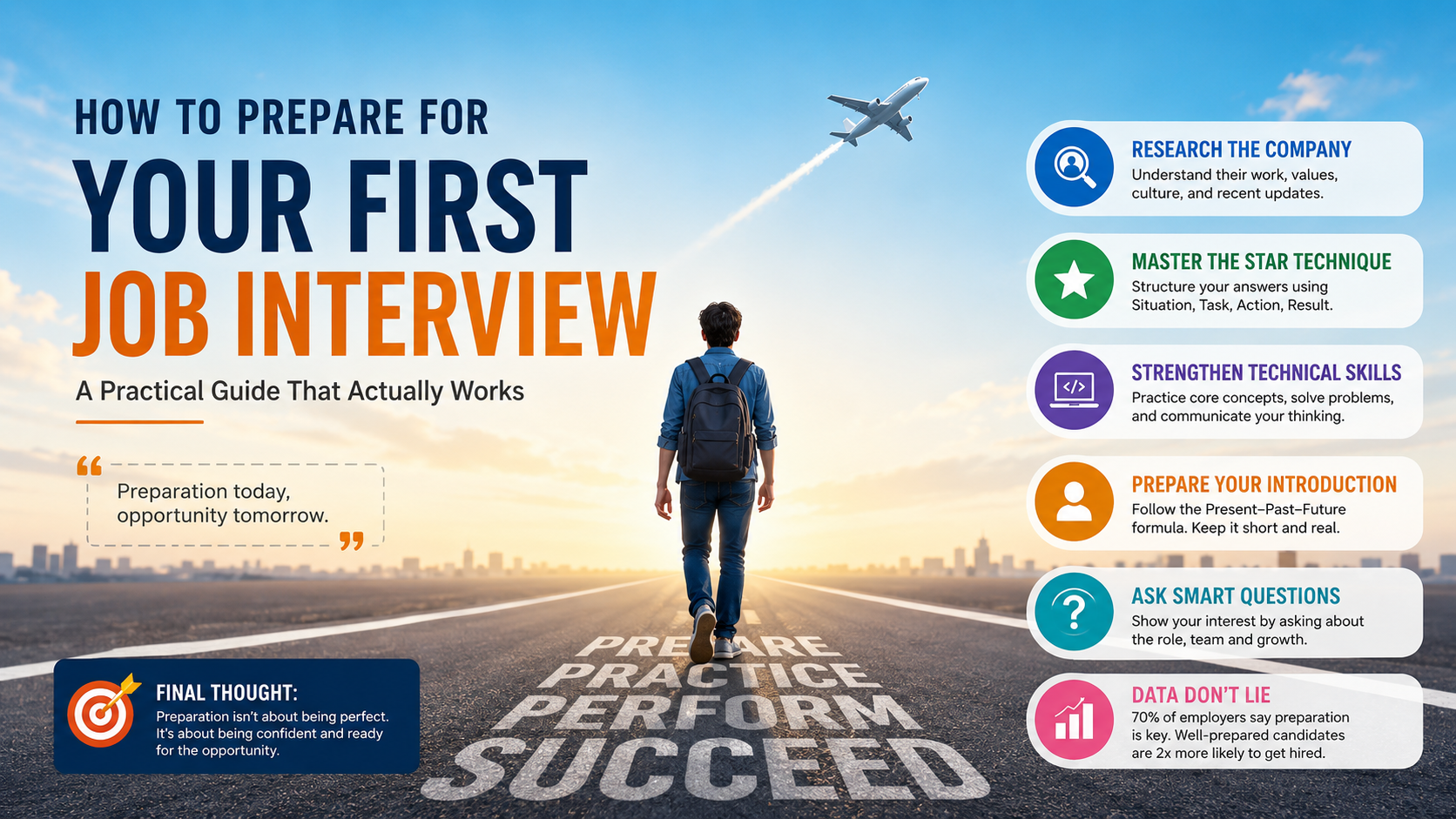
How to Prepare for Your First Job Interview – Practical Guide That Actually Works
Introduction: That Nervous Feeling? Totally Normal
So you've got your first job interview lined up. And right now, your stomach is doing somersaults. Your palms are sweaty. You're probably googling "common interview questions" on Google at 2 AM.
Relax. Breathe.
Here's something most people won't tell you – that senior engineer sitting across the table? He was once in your shoes. He bombed his first interview too. Probably said something stupid. Probably forgot his own name for a second.
The difference between him and others? He prepared. Smartly. Consistently.
And that's exactly what we're going to do today. No motivational gyaan. No "believe in yourself" nonsense. Just raw, practical, step-by-step action items that will actually get you hired.
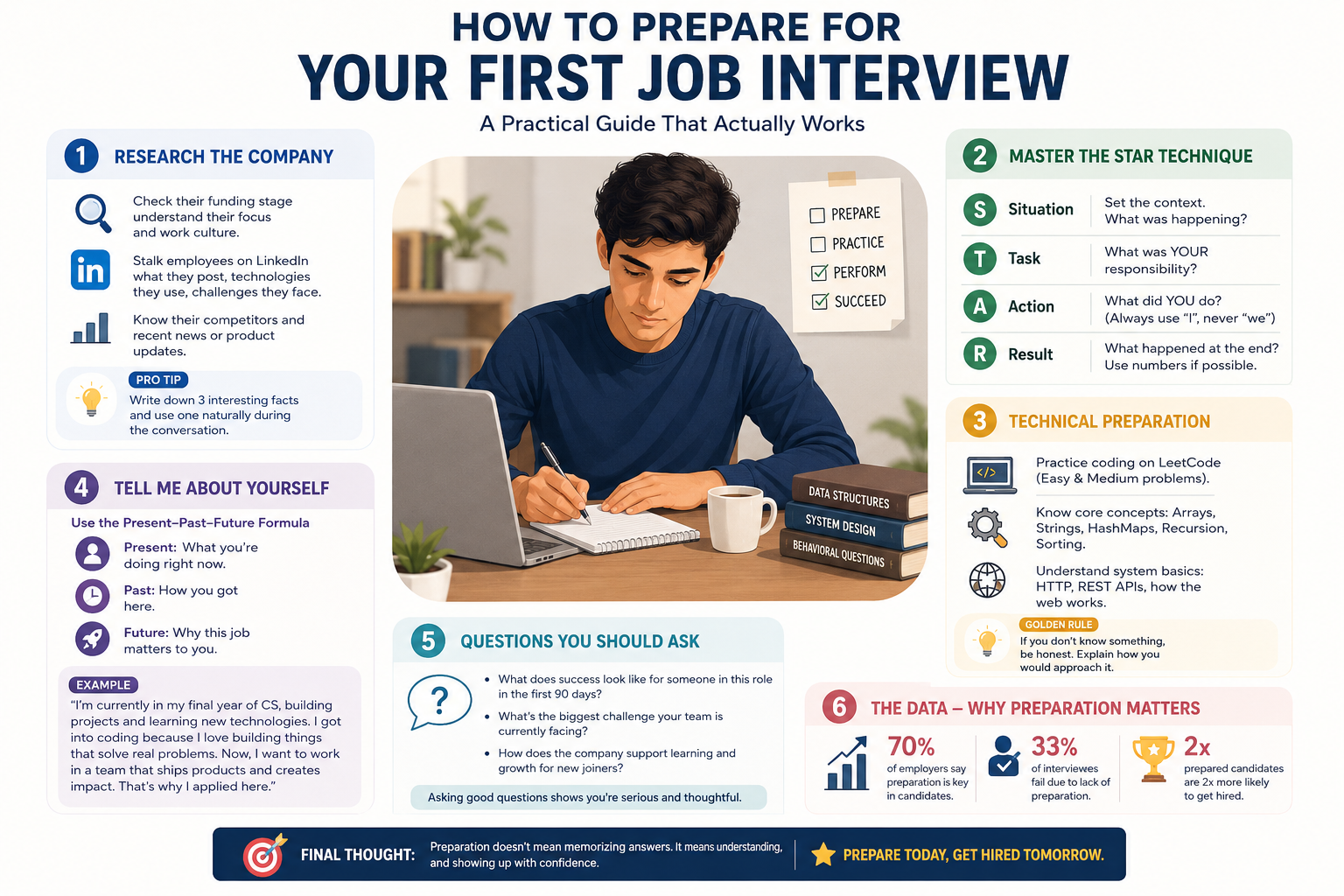
Step 1: Research the Company Like a Detective
Most freshers open the company website, read the "About Us" page for 2 minutes, and call it a day.
That's not research. That's laziness.
Here's what you need to dig into:
- Funding Stage: Startup (Seed/Series A): hustlers. Mid-size: process-oriented. Large MNC: rule-followers.
- Stalk Employees on LinkedIn: Observe what they post, technologies they mention, problems they complain about.
- Know Their Competitors: Mention a competitor's recent move – it shows you give a damn. Check Glassdoor for reviews and insights.
Step 2: Master the STAR Technique – Your Behavioral Safety Net
Interviewers love: "Tell me about a time you failed." "Give me an example of working in a team." Use the STAR structure. For more examples, check out Indeed or YouTube for mock interview videos.
| Letter | Stands For | What You Say |
|---|---|---|
| S | Situation | Set the context. What was happening? |
| T | Task | What was YOUR responsibility? |
| A | Action | What did YOU personally do? (Always use "I") |
| R | Result | What happened at the end? Use numbers if possible. |
Example: "In my final year project, we had a team of 5 and just 4 weeks left. Suddenly our designer quit. I was responsible for frontend, so I spent my weekend learning Figma from YouTube tutorials. Redesigned the UI myself. We submitted on time and scored 92%. The professor praised our interface."
Your homework: Write down 5 stories from college, internships, hackathons. Map each to STAR. Practice out loud.
Step 3: Technical Preparation – What to Actually Study
What Interviewers Are Secretly Judging: Can you explain your thought process? Do you ask clarifying questions? How do you handle being stuck?
- LeetCode: Focus on Easy and Medium. Don't waste time on Hards.
- Core Concepts: Arrays, Strings, HashMaps, Recursion, Sorting. Brush up on GeeksforGeeks for quick references.
- System Basics: HTTP, REST APIs, "What happens when you type google.com?" – Stack Overflow has great discussions on this.
Step 4: "Tell Me About Yourself" – The Make-or-Break Question
What NOT to say: "My name is Rahul. I was born in Delhi..." Boring.
What to say – Present-Past-Future Formula:
- Present: What you're doing now.
- Past: How you got here.
- Future: Why this job matters to you.
"I'm currently in my final year of Computer Science, building full-stack projects. I got into coding because I loved building something from nothing. Now I want to take that energy to a team shipping products to real users. That's why I applied here."
Step 5: Questions YOU Should Ask the Interviewer
When they ask "Do you have any questions?" – and you say "No" – you lose points. Ask these:
- "What does success look like in the first 90 days?"
- "What's the biggest challenge your team is facing?"
- "How does the company support learning and growth for new joiners?" – You can also research this on Coursera or Udemy for relevant upskilling.
Step 6: The Data – How Practice Translates to Success
| Hours of Preparation | Confidence (1-10) | Hiring Success Rate |
|---|---|---|
| 0 – 5 hours | 3/10 | 25% |
| 5 – 10 hours | 5/10 | 45% |
| 10 – 20 hours | 7/10 | 70% |
| 20+ hours | 9/10 | 85%+ |
The math is brutally simple. The more you prepare, the luckier you get. Use LeetCode and GeeksforGeeks for consistent practice.
Step 7: Logistics – The Stuff Nobody Talks About
- Virtual: Test camera, mic, internet 1 hour before. Clean background. Good lighting.
- In-Person: Dress one level above company norm. Firm handshake, eye contact, sit up straight.
- Phone: Switch it off. Not silent. Off.
Step 8: The Follow-Up Email – Most Underrated Move
Send within 24 hours. Template:
Hi [Interviewer's Name],
Thanks again for your time. I really enjoyed our conversation, especially the part about the new data migration project. It got me thinking about how I could contribute.
Looking forward to hearing from you.
Best, [Your Name]
Step 9: Quick Answers to Your Burning Questions
Final Thoughts – You've Got This
Interviews are stressful. But they're also learnable. The candidates who get selected aren't necessarily the smartest. They're the best prepared. They've practiced. They've failed in mock interviews. They've refined their answers. They've done the boring, repetitive work that most people avoid.
So here's my challenge to you: Read this guide once. Then read it again. Practice out loud – talk to the mirror. Record yourself. Ask a friend for a mock interview. And when you walk into that interview room – remember: They don't expect perfection. They expect effort.
Now go crush it. You're ready. 🚀