What Hiring Managers Look for in a Resume – Your 2026 Guide
"My resume is flawless. So why aren't I getting interviews?"
You've spent hours perfecting every bullet point, choosing the perfect font, and ensuring your dates align. Yet the silence from employers is deafening. The problem might not be your qualifications—it's that you're not showing hiring managers what they're actually looking for.
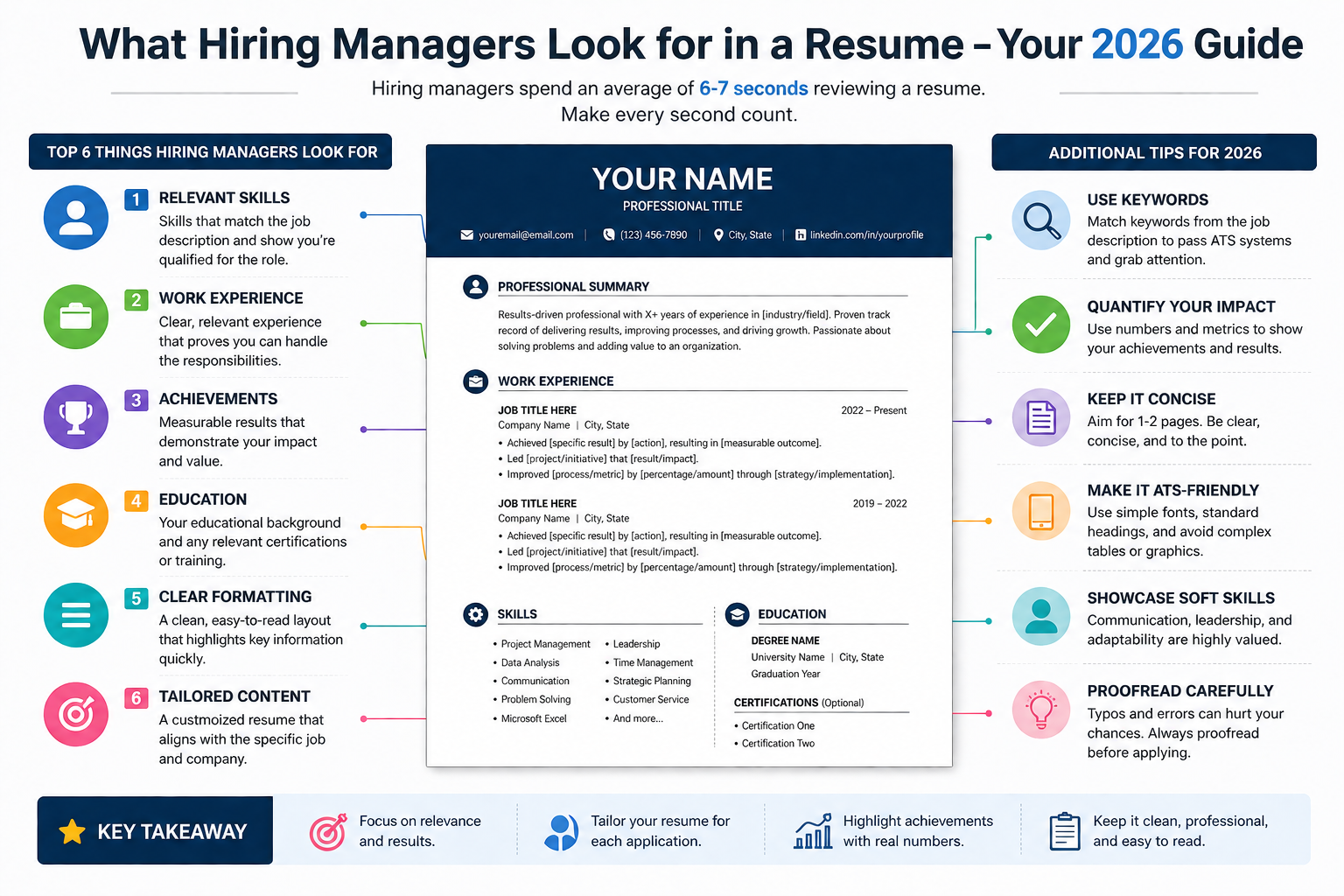
In 2026, hiring managers spend an average of just 6 to 7 seconds scanning a resume before deciding whether to move it forward or reject it. In that tiny window, they're looking for specific signals that tell them you're worth a closer look. This guide reveals exactly what those signals are.
Chapter 1: The 6-Second Scan – What Happens First
Hiring managers aren't reading your resume—they're scanning it. In the first few seconds, they're checking for four critical elements:
- Does it look professional? – Clean formatting, consistent fonts, and clear headings signal professionalism
- Are there obvious errors? – Typos and grammatical mistakes get immediate rejection
- Is it relevant? – Does your experience match the role?
- Are there quantifiable achievements? – Numbers and metrics grab attention instantly
Chapter 2: The First 30 Seconds – What They Actually Read
If the initial scan is successful, the hiring manager will spend up to 30 seconds on a deeper review. Here's exactly what they're looking for:
1. Professional Summary (The Hook): Your summary is your elevator pitch. It should answer three questions:
- Who are you?
- What do you bring to the table?
- Why should they care?
Strong Example: "Full-stack developer with 5+ years of experience building scalable web applications. Reduced page load times by 40% and increased user engagement by 25% at my previous role. Seeking to leverage my technical expertise to drive innovation at a forward-thinking company."
2. Recent Work Experience: Hiring managers prioritize your last two roles. They're looking for:
- Job titles that match the role
- Company names they recognize
- Tenure (how long you stayed)
- Achievements, not just responsibilities
3. Relevant Skills: They'll scan for specific keywords that match the job description. This is especially important if the company uses an Applicant Tracking System (ATS).
4. Education & Certifications: They'll check that you meet the minimum education requirements and note any relevant certifications.
Chapter 3: The 5 Core Elements Hiring Managers Prioritize
Hiring managers reject resumes that aren't tailored to the specific role. 55% of recruiters say the biggest resume mistake is not customizing it for the job.
What to do: Analyze the job description and mirror its language. If they ask for "project management experience," your resume should use that exact phrase, not "task coordination."
This is the single most important factor in 2026. Hiring managers want to see numbers, percentages, and dollar amounts that prove your impact.
Weak: "Responsible for social media management."
Strong: "Increased weekly social media engagement by 60%, generating 50,000 content interactions over a quarter, resulting in 40% follower growth."
Employers value candidates who take ownership. Look for evidence of leading projects, solving problems proactively, and mentoring others.
Example: "Led a cross-functional team of 8 to deliver a product 3 weeks ahead of schedule, saving $15,000 in project costs."
Hiring managers assess whether you'll integrate into the team. Use active language that reflects teamwork, collaboration, and problem-solving.
Example: "Collaborated with marketing and engineering teams to launch a unified product roadmap."
Hiring managers look for a pattern of professional growth and reasonable tenure. While you don't need to stay at a job forever, frequent moves (especially multiple jobs in the same year) can raise red flags.
Pro Tip: If you have gaps or short tenures, address them proactively in your cover letter.
Chapter 4: Common Mistakes That Get Your Resume Tossed
| Mistake | Why It Hurts | Fix |
|---|---|---|
| Typos and grammar errors | Signals carelessness and lack of attention to detail | Proofread multiple times and use tools like Grammarly |
| Generic objective statements | Recruiters care about what you can do, not what you want | Replace with a professional summary that states your value |
| Not using keywords | ATS can't find your resume | Mirror the language of the job description exactly |
| Listing duties instead of achievements | Doesn't show your impact | Use numbers and results to prove your value |
| Poor formatting | Makes your resume hard to scan | Use clean, consistent formatting with clear headings |
| Resume too long or too short | Losing recruiters' interest or looking inexperienced | Aim for 1-2 pages of relevant, focused content |
Chapter 5: How to Make Your Resume "Hiring Manager Proof"
- Start with a Strong Professional Summary: Your summary is the first thing hiring managers see. Make it count by showing your value and relevance immediately.
- Use Keywords from the Job Description: Analyze the job posting and incorporate its language into your resume. This ensures both ATS and human readers see your fit.
- Quantify Your Achievements: Use the "Action + Scope + Tool + Outcome" formula. Example: "Built a customer feedback system using Python that increased retention by 20%."
- Keep It Clean and Scannable: Use a simple layout with clear headings, bullet points, and consistent formatting. Fancy designs can confuse ATS and distract human readers.
- Tailor for Every Application: Yes, this takes time. But tailored resumes are 31% more likely to get selected than generic ones.
- Proofread Relentlessly: Errors are the fastest way to get rejected. Read your resume backward, use spell-check, and ask someone else to review it.
FAQ – Your Burning Questions Answered
Conclusion
Hiring managers are looking for three things: relevance, impact, and professionalism. Your resume is your first—and often only—chance to make a strong impression. By focusing on quantifiable achievements, using the right keywords, and presenting your experience in a clean, scannable format, you'll move from the "maybe" pile to the "yes" pile.
Your next step: Review your resume today. Is it tailored for the roles you want? Does it show your value with numbers? Is it error-free? If not, it's time to revise. 🚀