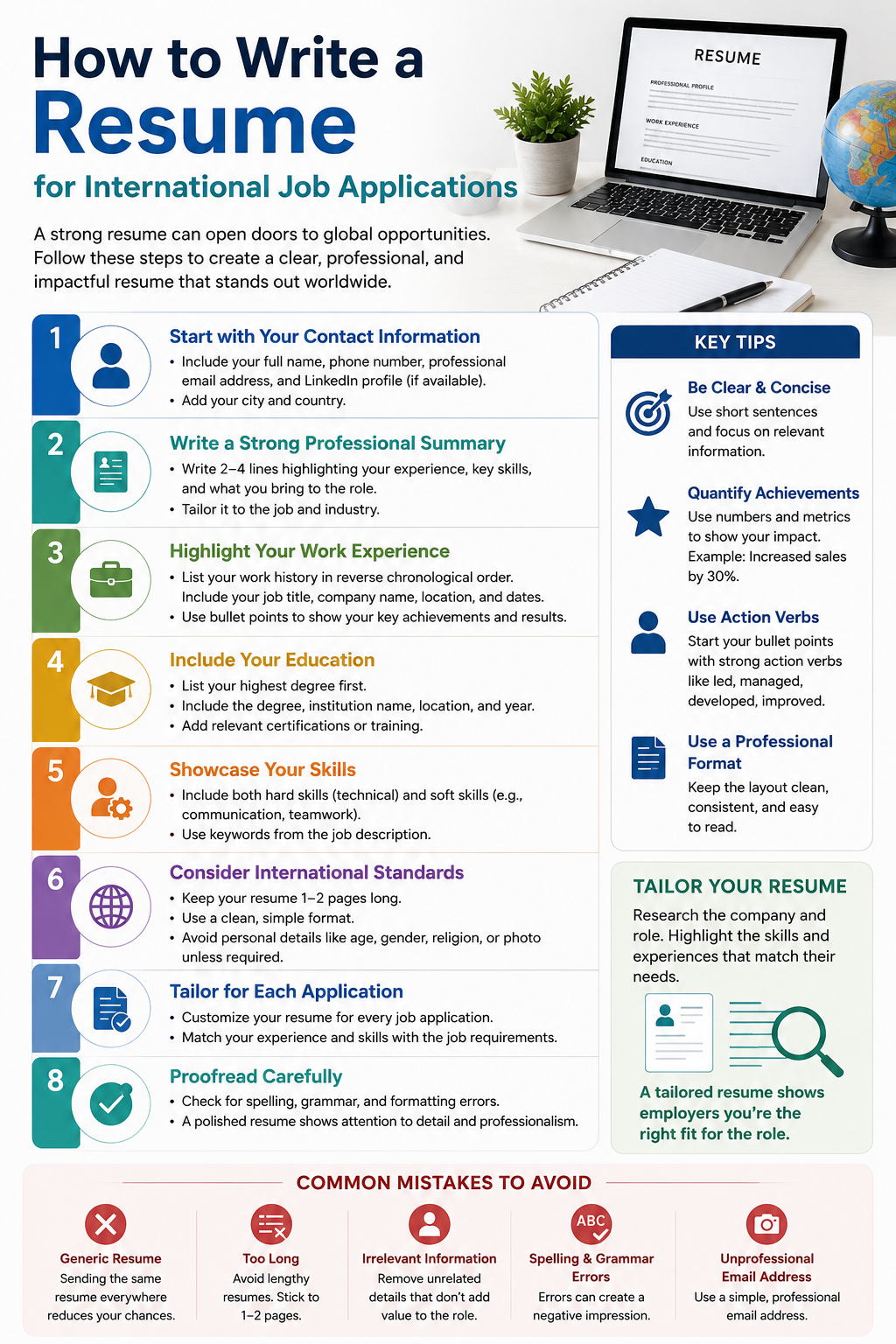
How to Write a Resume for International Job Applications – Your 2026 Guide
"My CV is flawless. So why aren't international employers calling me back?"
You can get interviews at home, but your international resume somehow lands in the digital void. The answer isn't your qualifications—it's cultural translation. The same resume that works in one country can fail completely in another, not because you lack skills, but because you didn't match local expectations.
A fundamental rule of resume writing is "know your audience," and that's especially true for overseas applications. Different countries have different norms for what belongs on a resume, what length is appropriate, and even how to format dates. This guide breaks down exactly how to craft an international resume that gets noticed.
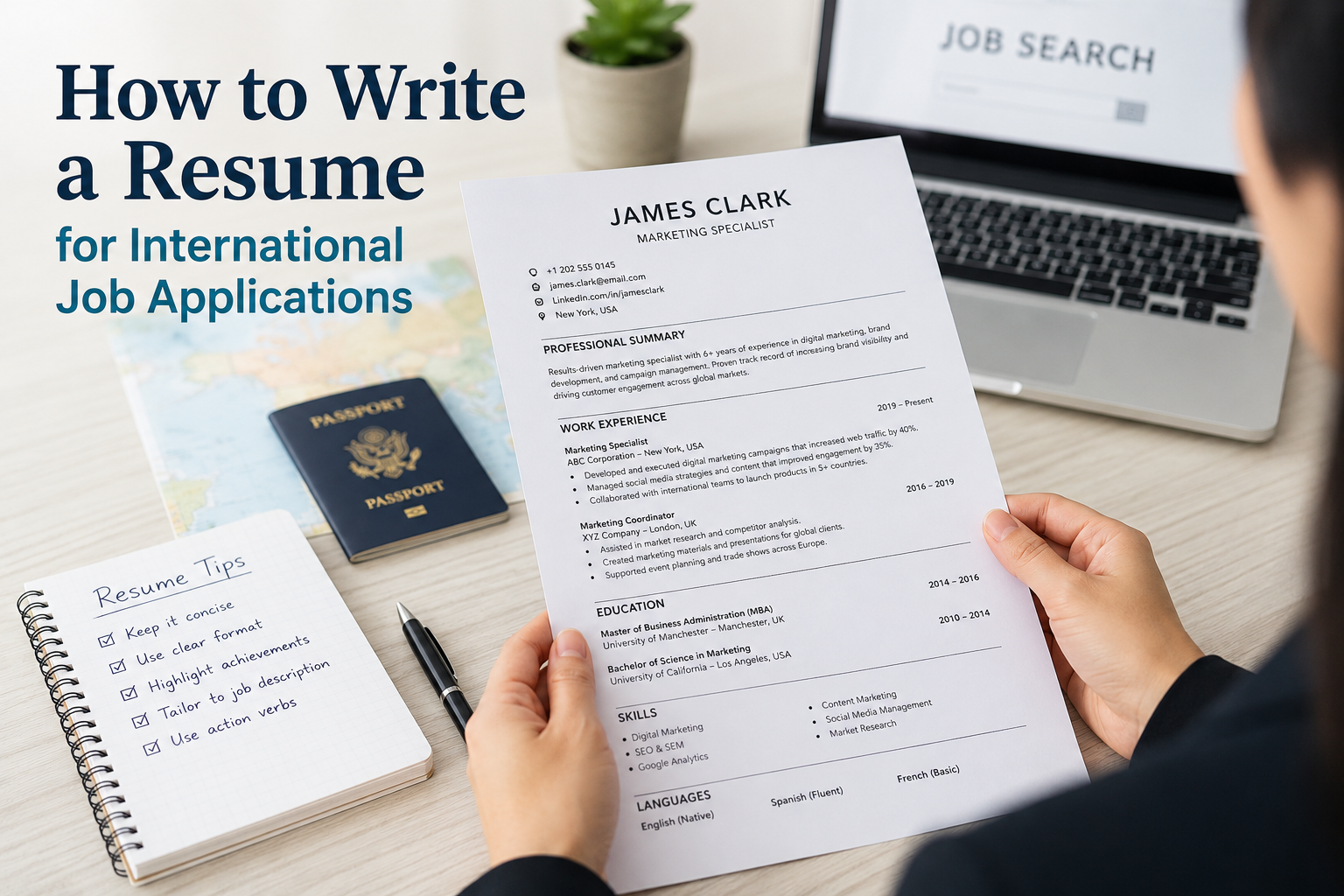
Chapter 1: CV vs. Resume – The Terminology Trap
Before writing anything, understand what you're actually creating. The terms "CV" and "resume" mean different things in different places.
In the US and Canada:
- A resume is a concise summary (typically 1-2 pages) highlighting experience relevant to a specific job
- A CV (curriculum vitae) is a longer, comprehensive document used primarily for academic, research, or medical positions
In the UK, Ireland, and many European countries:
- Employers use "CV" but usually expect a document that looks more like a US resume (2 pages max)
- The term "resume" is rarely used
In Australia and India: "CV" and "resume" are often used interchangeably.
Chapter 2: Research Your Target Country
Different countries have different expectations. Research is your first and most important step. Here's what varies:
Contact Details and Personal Information:
| Country | What to Include | What to Omit |
|---|---|---|
| US, UK, Canada, Australia | Name, professional email, phone with country code, LinkedIn link | Photo, date of birth, marital status, nationality, religion |
| Germany, France, many European countries | Full name, phone, email, sometimes date of birth and nationality | Marital status (generally), some personal details vary |
| Japan, South Korea | Often includes photo and date of birth | Some personal details vary |
Education Information: Degrees mean different things in different countries. If a university degree takes three years in one country and five in another, just stating the title isn't enough.
- Translate your qualifications into local equivalents when possible
- For recent graduates, provide details on coursework and projects
- For experienced professionals (5+ years), education becomes a simple line item
Date Formats: This is a common mistake. In the US, 05/06/2025 means May 6, 2025. In the UK and many other countries, the same date means June 5, 2025.
The fix: Write out the month: "June 5, 2025" or "5 June 2025".
Language and Local Jargon: Remove location-specific terminology that might confuse international recruiters. Terms like "Class XII," "first division," "articleship," or "tertiary" education may not translate well. Replace them with globally understood equivalents.
Chapter 3: Essential Sections to Include
1. Personal Details and Header
| What to Include | What to Avoid |
|---|---|
| Full legal name (largest text on the page) | Nicknames |
| Professional email address (firstname.lastname format) | Unprofessional email addresses |
| Phone number with country code | Photos, unless culturally expected |
| LinkedIn profile link (clickable) | Full street address |
| City and state/country (optional) | Marital status, age, religion, race, gender identity |
2. Professional Summary: This is your elevator pitch, typically 3-5 lines. Write a short paragraph that summarizes your years of experience, top achievements, and the specific problems you solve.
What to avoid: Using AI-generated summaries without editing—recruiters can detect them instantly. First-person pronouns like "I," "me," or "my".
"Results-driven Project Manager with 7+ years of experience in construction and infrastructure. Successfully delivered $15M+ in projects across Southeast Asia and the Middle East, consistently beating deadlines by an average of 12%. Seeking to leverage cross-cultural leadership skills in a challenging international PM role."
3. Core Competencies / Skills Section: List 8-12 relevant skills, pulled directly from the job description. Group them into categories like "Technical Skills," "Software," and "Languages" to make them easy to scan. Use exact keywords from the job description to pass through ATS filters.
Technical Skills: Project Management (PMP Certified), Risk Assessment, Budget Management
Software: MS Project, Jira, AutoCAD, Primavera P6
Languages: English (Fluent), Spanish (Professional Working), Mandarin (Conversational)
4. Professional Experience (Reverse Chronological): For each role, include:
- Job title
- Company name and location (city, country)
- Dates (month/year format: "June 2020 – December 2024")
- Bullet points: Start each with a strong action verb: "Spearheaded," "Generated," "Managed"
- Focus on achievements, not responsibilities
- Quantify everything possible with percentages, dollar amounts, or time saved
- Limit each role to 4-6 high-impact bullet points
Strong bullet point: "Led a 12-member cross-functional team to deliver a $2.1M infrastructure project 3 weeks ahead of schedule, saving $110,000 in operational costs."
5. Education: For international applications, include:
- Degree name
- Institution name and location
- Graduation year (omit if you graduated more than 15 years ago to prevent age bias)
- For recent graduates: relevant coursework, GPA (if above 3.5/4.0), and honors
- Provide context: Translate your GPA to a standard scale if possible. For example: "GPA 7/10, equivalent to U.S. GPA 3.84/4.00"
6. Certifications and Training: These build instant credibility, especially for international roles. Include:
- Certification name
- Issuing body
- Date earned
7. Language Skills: Always include languages, even if you think they're not relevant. Use standard proficiency levels:
- Native / Bilingual
- Fluent
- Professional Working
- Conversational
- Basic
8. Visa Status: This is crucial for international applications. Include a brief note if you require sponsorship or already have work authorization. Employers need to know if you can legally work in their country.
- "Currently holds unrestricted work authorization in the UK."
- "Requires visa sponsorship for employment in the United States."
- "Eligible for working holiday visa in Australia."
9. (Optional) Additional Sections: Depending on your field, consider adding:
- Research and Publications (especially for academic/university roles)
- Volunteer Work (particularly for NGO/social impact roles)
- Relevant Projects (for early-career professionals)
- Professional Memberships (for regulated industries)
Chapter 4: Formatting for International Success
Length Guidelines:
| Experience Level | Recommended Pages |
|---|---|
| Entry to mid-level | 1-2 pages |
| Senior roles (P4-P5 level) | Up to 3 pages |
| Technical/Research (for UN/NGO roles) | 2-4 pages if highly technical |
ATS-Friendly Formatting: Most large international employers use Applicant Tracking Systems (ATS). To pass automated screening:
| Do This | Avoid This |
|---|---|
| Use a single-column layout | Tables, text boxes, or multiple columns |
| Use standard fonts (Arial, Calibri, Georgia) | Fancy, hard-to-read fonts |
| Use standard section headings | Creative or unusual headings |
| Save and send as PDF (to preserve formatting) | Sending as a Word document unless requested |
| Use simple bullet points (•, -, or *) | Symbols like checkmarks or arrows |
Paper Size Awareness: US and Canada use 8.5 × 11 inches. Most other countries use A4 (8.3 × 11.7 inches). This small difference can cut off important information when printing. Always format your resume for A4 when applying internationally.
Chapter 5: Highlighting What Matters Most
Cross-Cultural Experience: One of the most valuable things you can showcase is your ability to work across borders. Emphasize:
- International work experience (internships, jobs abroad)
- Experience with global or multicultural teams
- Remote collaboration with colleagues from different regions
- Multilingual skills
Quantify Your Impact: Across every industry and culture, numbers speak louder than vague claims. Recruiters want to know what you actually achieved.
- Weak: "Contributed to project success."
- Strong: "Reduced processing time by 30% and generated 100,000+ impressions across three markets."
Transferable Skills: Some skills are universally valuable, regardless of where you work. Highlight problem-solving, organization, communication, and customer service. These skills demonstrate adaptability and global readiness.
Remote and Digital Tools: In a remote-first job market, familiarity with global digital tools signals your ability to function in distributed teams. Mention tools like Slack, Trello, Notion, Jira, Zoom, or Figma if you've used them.
Chapter 6: Cultural Nuances and Country-Specific Tips
1-2 pages; no photo; focus on achievements; single-column format
Common Mistakes: Including photo; using more than 2 pages; listing personal details
1-2 pages; no photo; achievements over responsibilities; reverse chronological order
Common Mistakes: Photo inclusion; using "resume" instead of "CV"; listing personal details
Photo and date of birth often expected; detailed employment history; references included
Common Mistakes: Omitting expected personal details; applying with US-style resume
Photo often expected; personal details common; CV can be 2 pages
Common Mistakes: Omitting photo; using UK/US style without research
1-2 pages; no photo; strong focus on achievements and impact
Common Mistakes: Including photo; personal details
Photo sometimes included; personal details (nationality, marital status) more common than in West
Common Mistakes: Applying with Western resume without adjustments
Competency-based format; 2-4 pages; emphasize skills, achievements, and language abilities; no graphics
Common Mistakes: Fancy designs; CV over 3-4 pages for non-academic roles
Chapter 7: The Cover Letter
For international applications, a cover letter is often expected. Use it to:
- Explain your motivation for relocating to their country
- Provide context for your CV that would be hard to fit elsewhere
- Clarify your visa status (if you have it or need it)
- Show enthusiasm for the role and company
"I have been following [Company Name]'s expansion into the Asian market and am excited by the opportunity to bring my experience in [specific area] to this role. Having previously worked in [country] for three years, I am confident in my ability to navigate the cultural and business environment."
What to avoid: Generic, AI-generated cover letters that could apply to any role, anywhere.
Chapter 8: Common Mistakes to Avoid
| Mistake | Why It Hurts | What to Do Instead |
|---|---|---|
| Including unnecessary personal details | Can lead to discrimination, especially in the US, Canada, UK | Only include name, email, phone, LinkedIn, and optionally location |
| Using location-specific jargon | Confuses international recruiters unfamiliar with local terms | Use globally understood equivalents |
| Inconsistent date formats | Creates ambiguity about dates; recruiters may not know what you mean | Write out months fully: "June 5, 2025" |
| Not including language skills | You lose a major asset, especially for international roles | Include languages and proficiency levels |
| Forgetting visa status | If you need sponsorship and don't mention it, you waste everyone's time | Include visa requirements or work authorization clearly |
| Using overly complex formatting | ATS may not read it properly, and recruiters might be confused | Keep it simple and scannable |
| Leaving out achievements | Recruiters will assume you just did your job without impact | Quantify achievements with numbers and examples |
Chapter 9: Practical Checklist Before You Submit
Before you click "Submit," review this checklist:
• Professional summary tailored to the role
• Contact information complete (name, email, phone with country code, LinkedIn)
• Skills section with keywords from the job description
• Experience bullet points focused on achievements, not duties
• Quantifiable metrics wherever possible
• Education section (with relevant coursework if early-career)
• Certifications and training (if applicable)
• Language skills
• Visa status (if applicable)
• One to two pages (unless specified otherwise)
• A4-compatible margins
• Consistent, professional font (Arial, Calibri, or Georgia)
• Single-column format
• Clean, scannable layout with bullet points and white space
• No graphics, tables, or text boxes
• PDF format (unless requested otherwise)
• Consistent spelling style (British or American English)
• Clear, unambiguous date formats
• No AI-generated generic content
• Proofread for typos and grammar (ask someone else to check)
FAQ – Your Burning Questions Answered
Conclusion: Your Global Resume Is Your Passport
Writing a resume for international jobs isn't about starting over. It's about translating your story for a new audience. The same skills, achievements, and experiences are valuable anywhere—you just need to present them in a way that international recruiters can recognize, trust, and act on.
Your next steps:
- Research the specific norms and expectations of your target country
- Remove location-specific jargon and adapt your language
- Quantify your achievements with clear metrics
- Ensure formatting is clean and ATS-friendly
- Include key sections like language skills and visa status
- Proofread thoroughly—typos cost opportunities
The world is full of opportunities for skilled professionals. Your resume is the ticket to the next chapter of your career. Make it count. 🚀