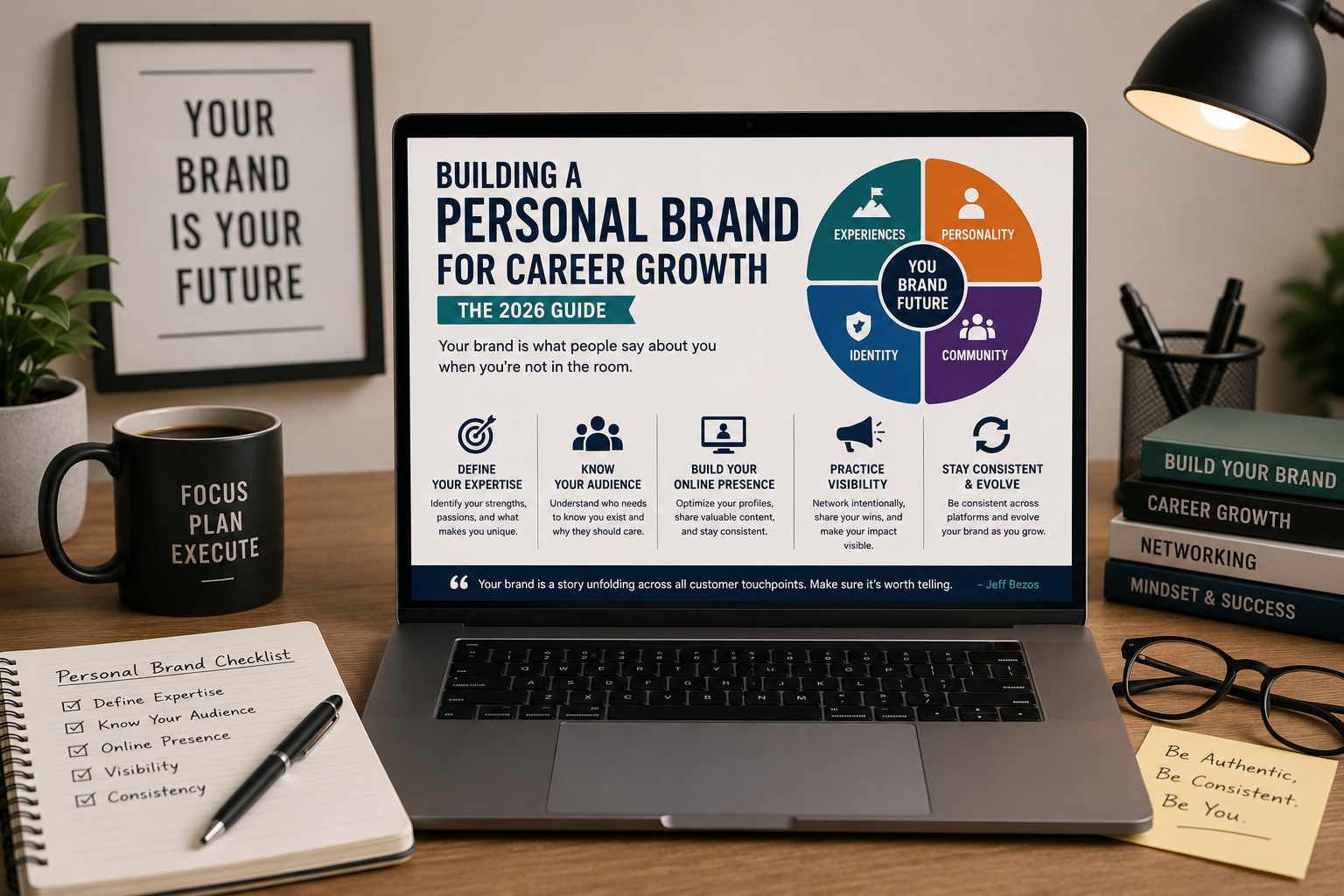
Building a Personal Brand for Career Growth – The 2026 Guide
Introduction: Your Brand Exists Whether You Manage It or Not
Here's a truth that might make you uncomfortable: you already have a personal brand. The question isn't whether you have one – it's whether you're shaping it intentionally or letting others define it for you.
In today's hyper-competitive job market, your CV alone won't open doors anymore. Employers are looking for something deeper – a clear identity that communicates who you are, what you stand for, and why you matter. As Jeff Bezos famously put it: "Your brand is what people say about you when you're not in the room."
The good news? Building a personal brand isn't about becoming an influencer or shouting about yourself on social media. It's about being intentional with how others experience you. Whether you're a fresh graduate, a mid-career professional, or someone transitioning industries, your personal brand is your career currency. And it's time to start investing.
Chapter 1: What Exactly Is a Personal Brand?
Let's clear up the confusion. Personal branding isn't narcissism – it's strategy.
Think of it this way: Your personal brand is the story of your reputation and the promises you keep when others work with you. It's the intersection of three things:
- How you see yourself – your values, strengths, and what drives you.
- How others see you – the reputation you've built through your actions and interactions.
- The alignment between the two – when these circles overlap, your brand becomes authentic and powerful.
Executive presence – a term you'll hear in performance reviews – breaks down into three elements:
- How you look – appearance, facial expressions, posture, how you carry yourself in a room.
- How you sound – pace, tone, the conviction behind your words.
- The emotional energy you project – the intangible cues people pick up before you've said very much at all. Are you confident? Anxious? Somewhere in between?
Personal branding is the wider umbrella that contains all of this. It's what you're known for when you're not in the room.
Chapter 2: Why Personal Branding Matters More Than Ever
The numbers don't lie. Here's what the data tells us:
| Statistic | Source |
|---|---|
| 92% of executives believe soft skills are more important than technical skills for leadership | LinkedIn Workplace Learning Report 2021 |
| Leaders with a strong professional reputation are 2.5x more likely to be promoted | Harvard Business Review |
| 70% of hiring managers have passed on a candidate based on their personal brand or online presence | CareerBuilder |
| 40% of millennials check out a CEO's personal brand before deciding to work at a company | Georgetown University Research |
Why this shift? In a world where nearly everyone has strong qualifications, what sets you apart is whether you can make a convincing argument for why you should be there – and whether you can build relationships in the room.
Your personal brand is also your insurance policy against job market volatility. If you've been with the same company for years and never built a network or public presence, you're vulnerable. Restructuring happens. Layoffs happen. Your personal brand ensures your value remains visible regardless of employment status.
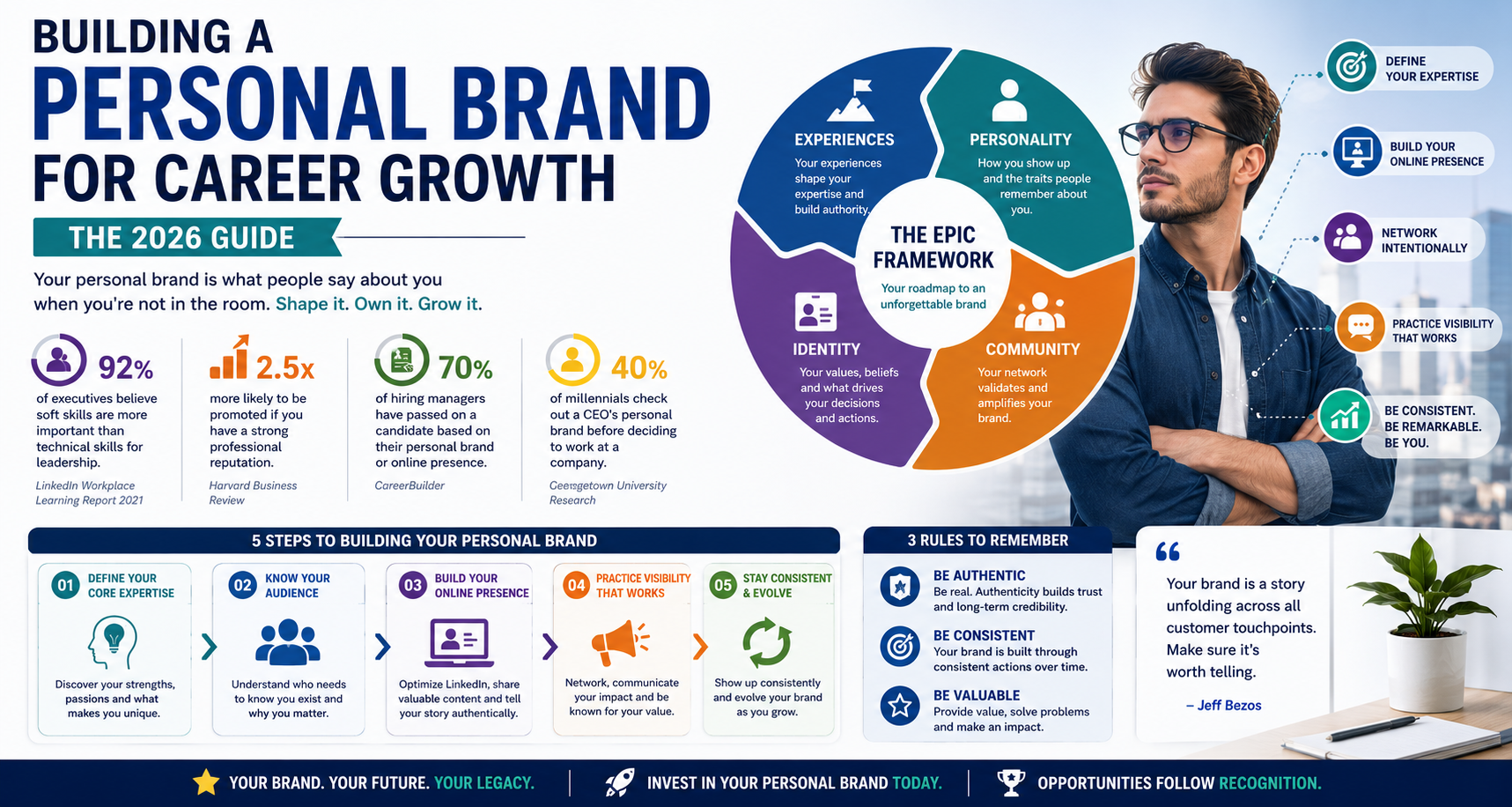
Chapter 3: The EPIC Framework – Your Roadmap to an Unforgettable Brand
Lorraine K. Lee, a founding editor at LinkedIn, developed a practical model called the EPIC career brand framework. EPIC stands for:
E – Experiences
This is everything you've done professionally and personally that shapes who you are today. Think about roles you've held, projects you've led, or challenges you've overcome. Sharing challenges or lessons learned is powerful – it helps people connect with you.
Action step: List out key details that matter to your audience. Instead of "I lead editorial here," say "I lead the editorial team collaborating with subject matter experts and influencers to create educational content for millions of users."
P – Personality
Your personality defines how people experience you. It's what they'll remember after a meeting ends. Are you collaborative? Analytical? Energetic? Calm under pressure? Be intentional about what you want others to see.
Action step: Identify the traits you want associated with your career. If you want to be known as a strategic thinker, demonstrate it consistently in meetings, presentations, and content you share.
I – Identity
Identity is about values, culture, and what drives you. Your identity influences how you communicate, how you lead, and how you make decisions. When you understand it, you show up more authentically.
Action step: Articulate the values you operate by – integrity, reliability, relationship-building – and then show them in action. It's not just about saying your values; it's about living them every day.
C – Community
Community ensures your brand is recognized and reinforced by others. Even the strongest brand doesn't exist in a vacuum. Peers, mentors, and your network should see and validate the brand you're trying to build.
Action step: Ask for feedback, share goals with trusted colleagues, and make sure your achievements and style are visible in speaking engagements, meetings, and across social platforms.
Chapter 4: Step 1 – Define Your Core Expertise
Before you can build a brand, you need to know what you're building on. Here's how:
- Identify Your "Genius Zones": Pay attention to the moments when you feel focused, energized, and confident. These experiences often reveal what sets you apart.
- Ask yourself: What are my top three areas of expertise – not just from work, but across my entire life journey? What do people come to me for help with? What problems do I genuinely care about solving?
- Define Your "Special Sauce": Differentiation happens across three levels: Functional (what you do), Differentiation (what makes you unique), and Emotional (how people feel after interacting with you).
- Seek Specific Feedback: Find two people you trust and ask them: What do people say about me when I'm not in the room? How would others describe me as a professional? What words would you use to define my reputation?
Chapter 5: Step 2 – Know Your Audience
Here's where most people are surprised: 90% of personal branding isn't about you – it's about your audience.
Ask yourself: Who needs to know you exist? Why should they care?
Your audience could be potential employers, clients, collaborators, or peers in your field. Each group may need to see you in a slightly different way.
Action step: Write your online presence and content for the "who" – the people you want to discover you. Then stay visible by doing regular updates. This isn't about having a huge following – it's about career opportunities and the people you want to connect with.
Chapter 6: Step 3 – Build Your Online Presence
Your online presence is your 24/7 résumé. If someone Googles you right now, would they find something that makes them say, "We need that person?"
LinkedIn: Your Primary Professional Platform
Your LinkedIn profile is different from a CV. A CV is a historical statement of your work and education. LinkedIn is more – it's where you tell your career story.
- Tailor your profile to the people you want to see it.
- Keep it updated – don't copy-paste from your CV.
- Use keywords people would search for – mirror the language of job descriptions.
- Get recommendations – social proof is key.
- Don't tie your identity to a specific company – build your brand around your career achievements.
The "About" Section – Your Career Story: This is not a personal statement from your CV. It's where you tell your story – how you got to where you are now, your key strengths, and what you're looking to do next.
What to Post About: What you're working on, events you've attended, people you've met, what you've read/listened to/watched, and your opinion on topical subjects. Remember: You don't need to post often. Once a week or every two weeks is plenty.
Chapter 7: Step 4 – Practice "The Visibility That Works"
The era of letting your work speak for itself is over. Competition is too high, and bosses are too pressed for time to act as private investigators into who contributed what. It falls to you to make your impact legible.
- Be a System, Not a Salesperson: Find advocates who are in the rooms you're not yet in. Provide visibility for others – the more you give, the more it comes back.
- Practice Your Elevator Pitch: Script the structure, not the content. Two to three clear headlines about who you are and what you do are worth knowing by heart.
- Network Intentionally – But Don't Be Transactional: Go in genuinely curious. People who are asked interesting questions and given room to answer them tend to remember the person who asked.
- Stay Connected with Former Bosses: A text every few months, a note when something reminds you of them – the connection doesn't need to be managed so much as tended.
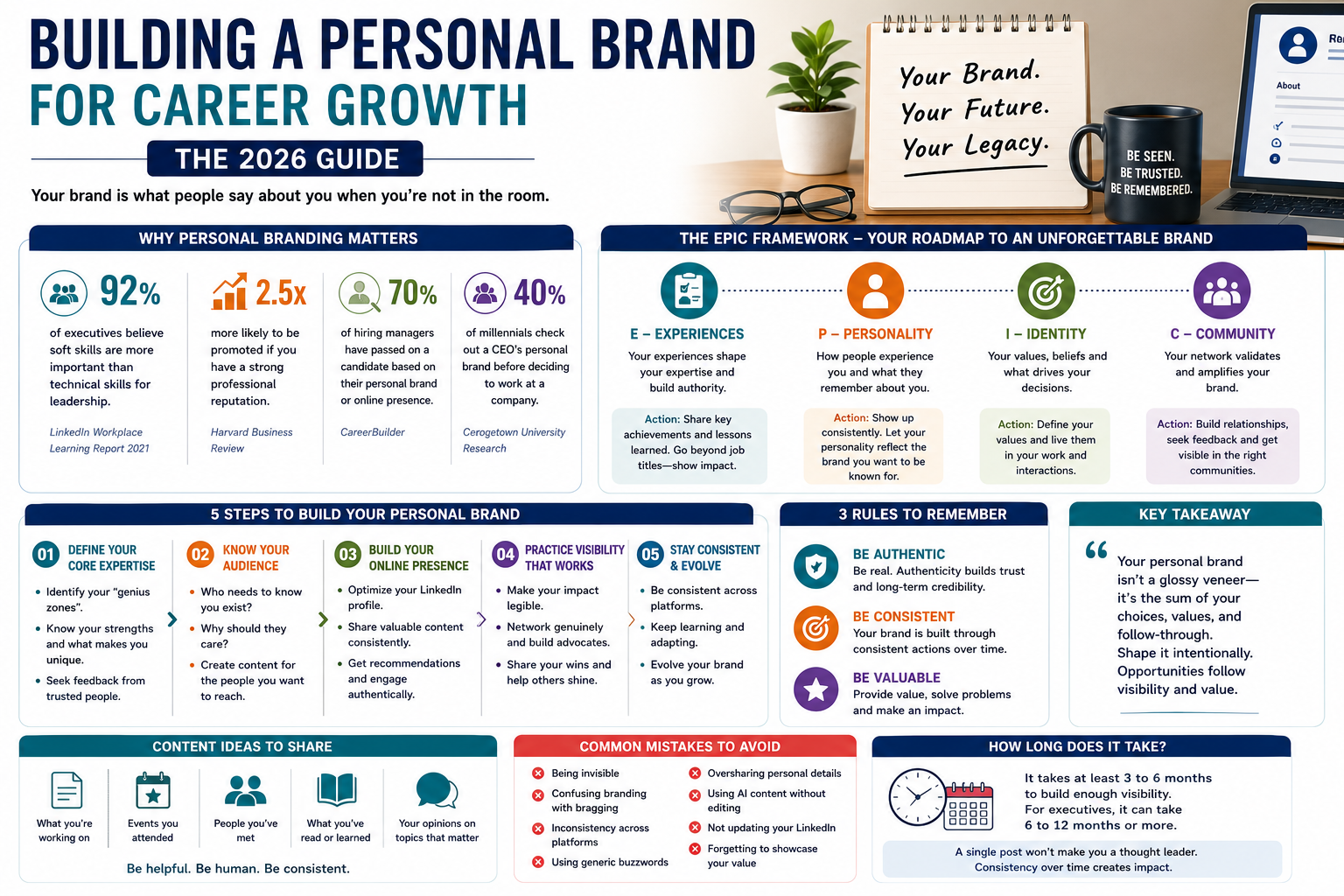
Chapter 8: Step 5 – Consistency Is Key
Consistency across platforms is non-negotiable.
What this means: Your message, tone, and visual identity should be the same across LinkedIn, Instagram, a personal portfolio, or any other platform. Use the same professional photo across platforms. Pick two or three core stories that reflect your values and repeat them across platforms.
Why this matters: Variety is not the goal. It's about being unmistakably you, everywhere you are. This builds credibility and recognition.
The timeframe: Building a personal brand takes time. Even if you're head-down in your work and haven't built an online presence yet, it takes at least three to six months to build enough evidence to be more visible. For executives, that time frame can double.
Chapter 9: The 3 Verbs – Build, Protect, Leverage
Jennifer Dalton, founder of BrandMirror, organizes the ongoing work of branding into three verbs:
- Build: Continue to create content, publish ideas, and showcase expertise.
- Protect: Safeguard your intellectual property – especially in a world of AI and content replication.
- Leverage: Get visible: pitch yourself for podcasts, volunteer for panels, or collaborate on projects.
"People follow leaders, not logos," Dalton says. "Your personal brand is the story of your reputation and the promises you keep when others work with you."
Chapter 10: Common Mistakes to Avoid
| Mistake | What to Do Instead |
|---|---|
| Being invisible | Invisibility is a career killer. You must make your impact legible. |
| Confusing branding with bragging | Offer value in your content. Don't just announce achievements – share insights. |
| Inconsistency across platforms | Your message, tone, and visual identity should be the same everywhere. |
| Using generic buzzwords | Avoid phrases like "passionate about the environment" or "results-driven." Show what you mean with concrete examples. |
| Oversharing personal details | Overly personal content can backfire and weaken your professional image. |
| Using AI-generated content without editing | AI doesn't have your work experience or career stories. Edit outputs to avoid cliches and be transparent. |
| Not updating your LinkedIn | Keep it updated and in the correct tense (past for past roles). |
Chapter 11: Quick Reference Table – Personal Branding Actions
| Area | Action | Frequency |
|---|---|---|
| Define | Identify your top 3 expertise areas and values | Once, revisit every 6-12 months |
| Audience | Know who needs to know you exist | Before creating any content |
| Update profile, write your "About" section, get recommendations | Ongoing | |
| Content | Post insights, share takeaways, comment thoughtfully | Once a week or every two weeks |
| Networking | Attend events, connect genuinely, follow up | Monthly (real-world); Weekly (online) |
| Visibility | Send regular outcome-focused updates to your manager | Fortnightly |
| Feedback | Ask 2 trusted people about your brand | Every 6 months |
Chapter 12: FAQ – Your Burning Questions Answered
Conclusion: Your Brand Is Alive – Shape It
Here's the bottom line: Your personal brand isn't a glossy veneer – it's the sum of your choices, values, and follow-through.
Like any good brand, a personal brand is never finished; it evolves as you do. The question isn't whether you have one – it's whether you're shaping it.
Remember:
- You already have a personal brand – are you intentional about it?
- Focus on clarity and authenticity – that's what resonates.
- Showcase your value to the people that matter – keeping your own objectives in mind.
- Consistency and visibility are the keys to generating opportunities.
Telepathy is not a strategy. You can't expect people to just know what you're good at. You have to show them.
Now go shape your brand. Your future career growth depends on it. 🚀